
Acmaeodera quadrivittatoides
Nelson & Westcott, 1995
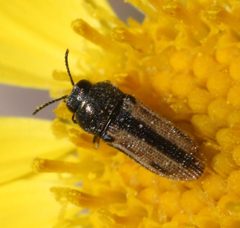
Acmaeodera quadrivittatoides is a metallic wood-boring beetle in the Buprestidae, described by Nelson & Westcott in 1995. The occurs in Central America and North America, with documented records from the southwestern United States and Mexico. Field observations indicate are attracted to flowers, particularly those of Opuntia species and various composites, where they feed on pollen.
Pronunciation
How to pronounce Acmaeodera quadrivittatoides: /ˌæk.miːoʊˈdɛr.ə ˌkwɒd.rɪˌvɪt.təˈɔɪd.iːz/
These audio files are automatically generated. While they are not always 100% accurate, they are a good starting point.
Images
Distribution
Central America and North America. Documented from the southwestern United States (New Mexico, Texas, Arizona) and Mexico. GBIF records indicate presence in both Nearctic and Neotropical regions.
Seasonality
have been observed active from late spring through summer. Field records from New Mexico and Texas indicate peak activity in May and June, with specimens collected as late as July.
Diet
feed on pollen. Observed on flowers of Opuntia (pricklypear cacti), Thelesperma species (rayless threadleaf), and other yellow-flowered composites.
Host Associations
- Opuntia macrorhiza - feedingprairie pricklypear cactus flowers
- Opuntia camanchica - feedingtulip pricklypear cactus flowers
- Opuntia phaeacantha - feedingbrown-spined pricklypear cactus flowers
- Thelesperma magnicamporum - feedingrayless threadleaf flowers
- Thelesperma megapotamicum - feedingrayless slenderthread flowers
- Melampodium leucanthum - feedingblackfoot daisy flowers
- Helianthus annuus - feedingcommon sunflower flowers
- Hymenopappus flavescens - feedingcollegeflower flowers
- Lorandersonia pulchella - feedingsouthwestern rabbitbrush flowers
- Psilostrophe tagetina - feedingwoolly paperflower flowers
- Gaillardia sp. - feedingblanketflower flowers
- Prosopis glandulosa - feedinghoney mesquite flowers
- Xanthisma spinulosum - feedingspiny goldenweed flowers
- Erigeron sp. - feedingfleabane flowers
- Senna roemeriana - feedingtwo-leaved senna flowers
Behavior
are flower visitors, often found resting inside curled petals during evening hours. Frequently observed in association with other Acmaeodera on shared floral resources. activity appears temperature-dependent, with reduced activity during cool or windy conditions.
Similar Taxa
- Acmaeodera mixtaSympatric and frequently co-occurs on identical floral ; requires careful examination of elytral maculation patterns for separation
- Acmaeodera ligulataOverlapping distribution and shared use of Melampodium and Opuntia flowers; differs in elytral pattern and body proportions
- Acmaeodera tubulusSimilar size and general appearance; A. quadrivittatoides has more distinct longitudinal vittae on
- Acmaeodera scalarisFound in similar and on overlapping ; A. quadrivittatoides typically shows four more prominent vittae
- Acmaeodera immaculataSympatric in sand dune ; A. quadrivittatoides has distinct elytral markings while A. immaculata is relatively unmarked
More Details
Taxonomic history
The name 'quadrivittatoides' refers to its resemblance to species with four vittae (longitudinal stripes), particularly Acmaeodera quadrivittata, with which it was previously confused. The specific epithet translates roughly to 'resembling four-striped'.
Collection method
Most effectively collected by sweeping or hand-picking from flowers of known plants during mid-day hours when temperatures exceed 70°F. Beating sheet techniques are generally ineffective; visual searching and aerial netting of flying individuals near flowers is more productive.
Conservation status
No formal conservation status has been assigned. Appears to be locally common within its range where suitable floral resources and appropriate climatic conditions coincide.