
Acmaeodera immaculata
Horn, 1878
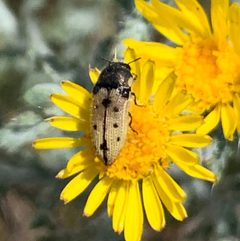
Acmaeodera immaculata is a metallic wood-boring beetle in the Buprestidae. The has been documented from northwestern Oklahoma through Colorado and into Alberta, Canada, with observed visiting flowers of Helianthus, Sphaeralcea, and other composite and mallow species. It belongs to a including A. mixta and A. pulchella that can be difficult to distinguish without close examination.
Pronunciation
How to pronounce Acmaeodera immaculata: /ˌækmiːoʊˈdɛrə ˌɪmækjʊˈleɪtə/
These audio files are automatically generated. While they are not always 100% accurate, they are a good starting point.
Identification
are small to medium-sized buprestids with metallic coloration. Distinguished from similar in the A. mixta/pulchella/immaculata complex by specific elytral punctation and coloration patterns; precise identification requires examination of genitalia or other microscopic features. The species tends to be smaller than A. mixta in some , though size overlap occurs.
Images
Habitat
have been collected in shortgrass prairie, pinyon-juniper woodland, and sand dune margins. Associated with areas where flowers (Helianthus, Sphaeralcea) are abundant. The occurs in western Oklahoma, Colorado, and northward into Alberta, Canada.
Distribution
North America: documented from northwestern Oklahoma (Woodward, Major, Beaver, Cimarron counties), Colorado (vicinity of Vogel Canyon), and Alberta, Canada. Represents a western Plains and intermountain distribution with recent range extension to Canada.
Seasonality
activity observed in late June through August, with peak abundance in July. Specimens collected from flowers during warm, sunny conditions.
Behavior
are flower visitors, frequently observed on yellow composite flowers (Asteraceae) and globemallows (Malvaceae). Has been collected from Helianthus anomalus, Helianthus petiolaris, Sphaeralcea grossulariifolia, Sphaeralcea ambigua, and Sphaeralcea parvifolia. Attracted to white bottle traps placed in prairie and woodland edge .
Similar Taxa
- Acmaeodera mixtaOverlapping distribution and similar appearance; distinguished by elytral punctation and pattern, and generally larger size
- Acmaeodera pulchellaMember of same with similar flower-visiting ; requires microscopic examination for reliable separation
- Acmaeodera tubulusSimilar size and flower-visiting habit, but eastern with different elytral
More Details
Trapping records
Collected in white bottle traps in northwestern Oklahoma study (2023), with specimens recorded from Gloss Mountain State Park, Alabaster Caverns State Park, Beaver Dunes Park, and Black Mesa State Park areas. Trap catches typically numbered 1-8 individuals per trap check in late July.
Photographic documentation
Well-documented in field photography, including images with natural sky backgrounds showing characteristic metallic coloration. Sunset photography of this has been featured in natural history blogging.