
Acmaeodera pulchella
(Herbst, 1801)
Flat-headed Bald Cypress Sapwood Borer, Flat-headed Baldcypress Sapwood Beetle
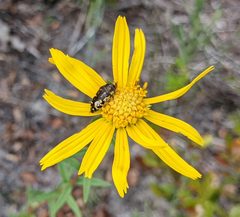
Acmaeodera pulchella is a metallic wood-boring beetle in the Buprestidae, commonly known as the flat-headed bald cypress sapwood borer. The is widely distributed across North America, with records from the United States and Canada including Manitoba and Ontario. It is associated with bald cypress (Taxodium distichum) based on its , though specific ecological relationships require further documentation. are active during summer months and have been observed on flowers of herbaceous vegetation in prairie and open woodland .
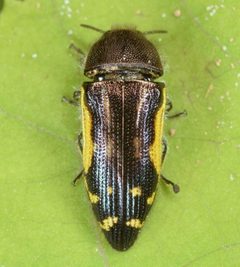
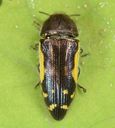
Pronunciation
How to pronounce Acmaeodera pulchella: /ækˌmiːoʊˈdɛrə pʊlˈkɛlə/
These audio files are automatically generated. While they are not always 100% accurate, they are a good starting point.
Images
Habitat
Found in prairie remnants, xeric dolomite prairies, dry post oak woodlands, and open areas with herbaceous vegetation. One observation records it from roadside vegetation in dry mesic upland deciduous forest. The has been swept from herbaceous vegetation rather than collected directly from woody .
Distribution
North America. Documented from the United States and Canada, specifically including Manitoba and Ontario in Canada. GBIF records indicate presence in the Nearctic and Neotropic regions.
Seasonality
Summer. A field observation from Peck Ranch Conservation Area in Missouri records collection in mid-July, with the collector noting it as a "common summertime " in that region.
Host Associations
- Taxodium distichum - sapwood borerimplied by ; larval not directly confirmed in sources
Behavior
have been collected by sweeping herbaceous vegetation, including roadside vegetation in dry mesic upland deciduous forest. One collector noted it as a "common summertime " in Missouri.
Similar Taxa
- Acmaeodera texanaSimilar size and appearance; both found on flowers of Liatris hirsuta (hairy blazingstar) in xeric dolomite prairie. A. texana is distinguished as "very uncommon" where A. pulchella is "common."
- Acmaeodera mixtaSympatric in prairie ; both flower-visiting in the same requiring close examination for separation.
- Acmaeodera ornatoidesFound in similar prairie flower ; both visit composite flowers and require careful morphological comparison.
More Details
Collection method
The is frequently encountered through sweeping herbaceous vegetation rather than beating woody vegetation, suggesting may feed on pollen or nectar from herbaceous flowers rather than being strictly associated with their larval plant as adults.
Abundance
Described as "common" in Missouri during summer months, in contrast to such as A. texana which are noted as "very uncommon" in the same region.