
Acmaeodera texana
LeConte, 1860
Texas jewel beetle
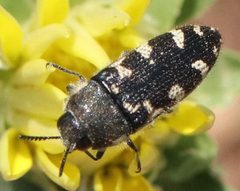
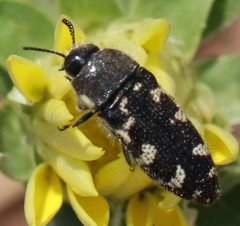
Acmaeodera texana is a metallic wood-boring beetle in the Buprestidae, first described by LeConte in 1860. It occurs in North America, with records from the southwestern United States and Mexico. The is considered uncommon in many parts of its range, including Missouri where it has been recorded only sporadically. have been observed visiting flowers of Liatris hirsuta and other herbaceous plants in xeric prairie .
Pronunciation
How to pronounce Acmaeodera texana: /ækmiːəˈdɪərə tɛkˈsɑːnə/
These audio files are automatically generated. While they are not always 100% accurate, they are a good starting point.
Identification
Acmaeodera texana can be distinguished from the more common A. pulchella by its larger size and more robust body form. The elytral maculation pattern differs, with A. texana typically showing more irregular spotting rather than the distinct vittae seen in A. pulchella. In Missouri, A. texana is notably uncommon compared to A. pulchella, which is abundant in summer.
Images
Habitat
Xeric dolomite prairie remnants and glades; associated with herbaceous vegetation in dry, rocky prairie . have been found on flowers of Liatris hirsuta (hairy blazingstar) and swept from surrounding vegetation in xeric dolomite prairie.
Distribution
Nearctic region; recorded from North America including southwestern United States (Texas, New Mexico, Arizona) and Mexico. In the central United States, known from Missouri (uncommon), with specific records from Mincy Conservation Area in Taney County.
Seasonality
Summer; active in July and August based on collection records. In Missouri, observed in mid-July.
Behavior
have been observed visiting flowers, specifically Liatris hirsuta, suggesting nectar-feeding . Readily taken by sweeping herbaceous vegetation in prairie .
Ecological Role
Flower visitor in xeric prairie ; potential of prairie forbs.
Similar Taxa
- Acmaeodera pulchellaCommon summer in Missouri that overlaps in and season; distinguished by smaller size, more slender build, and more regular elytral vittae versus irregular spotting in A. texana.