
Gyascutus planicosta cribriceps
Casey, 1909
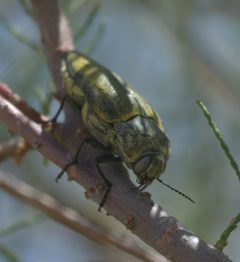
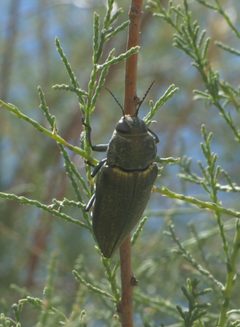
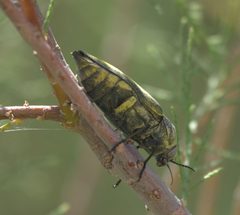
Gyascutus planicosta cribriceps is a of jewel beetle in the Buprestidae, native to the southwestern United States and northern Mexico. It is one of the larger buprestid beetles in North America and is known to occur on willow (Salix) as well as other plants. The subspecies is part of a complex that was formerly treated as a subgenus of Hippomelas but is now recognized as the distinct Gyascutus. are active during summer months and can be collected by beating host vegetation or observed in .
Pronunciation
How to pronounce Gyascutus planicosta cribriceps: //dʒaɪˈæskjuːtəs ˌplænɪˈkoʊstə ˈkrɪbrɪˌsɛps//
These audio files are automatically generated. While they are not always 100% accurate, they are a good starting point.
Identification
Distinguished from related Gyascutus by the combination of elytral and coloration pattern characteristic of the nominate planicosta, with subspecific distinction based on pronotal and elytral punctation (cribriceps = 'sieve-headed,' referring to dense punctation). Larger than most North American buprestids; may exceed 20 mm in length. Separated from Hippomelas proper by the flatter, less convex body form and different elytral sculpturing. The related Gyascutus caelatus occurs further south in Arizona and Mexico, while G. fulgidus overlaps in range but differs in coloration and surface texture.
Images
Habitat
Arid and semi-arid regions of the southwestern United States; associated with riparian corridors and washes where plants grow. Collected from willow (Salix) and other woody vegetation in desert scrub and grassland environments. Occurs at lower to middle elevations in areas with adequate moisture to support host plant growth.
Distribution
Southwestern United States (western Texas, southern New Mexico, southeastern Arizona) and northern Mexico. Records from Chihuahuan and Sonoran Desert regions. The appears to be more western in distribution compared to other forms of G. planicosta.
Seasonality
activity recorded from July through August; peak likely coincides with summer monsoon rains and plant flowering.
Diet
Larvae develop in living or recently dead wood of plants, specifically willow (Salix spp.) and possibly other woody plants in the Salicaceae or related riparian . feed on foliage or may take nectar; specific adult diet poorly documented.
Host Associations
- Salix - larval willow
- Prosopis glandulosa - associationmesquite; observed resting or feeding
Life Cycle
Holometabolous with wood-boring larvae. Larvae tunnel in sapwood and heartwood of trees, likely requiring one or more years to develop. occurs in wood; emerge through circular exit holes. Newly emerged adults may retain a pale waxy bloom that rubs off with activity.
Behavior
are strong fliers and can be observed flying rapidly between plants or taking evasive when disturbed. Readily takes flight when approached; collected by tracking flight paths to landing sites or by beating host vegetation. activity at lights has not been documented for this .
Ecological Role
Larval wood-boring contributes to nutrient cycling in riparian ; may serve as prey for woodpeckers and other . may function as when feeding on flowers.
Human Relevance
Of interest to coleopterists and natural historians due to large size and striking appearance. Not considered an economic pest. Specimens sought by collectors; can be difficult to obtain due to flighty and specific requirements.
Similar Taxa
- Gyascutus caelatusOverlaps in Arizona; distinguished by brighter metallic green or blue coloration and more strongly convex body form
- Gyascutus fulgidusSympatric in parts of range; differs in coloration and elytral sculpturing, often more bronzy or coppery
- Hippomelas sphenicusFormerly placed in same ; distinguished by more convex body, different elytral striation, and typically more southerly distribution
- Gyascutus planicosta planicostaNominate ; differs in pronotal and elytral punctation , with cribriceps having denser, more cribriform (sieve-like) punctation