
Hippomelas
Laporte & Gory, 1837
Species Guides
3Hippomelas is a of jewel beetles ( Buprestidae) established by Laporte and Gory in 1837. The genus comprises approximately ten described distributed in western North America and Mexico. Members are large, robust buprestids associated with woody legumes, particularly Acacia and Mimosa species. Several species have been documented through recent collecting efforts in the southwestern United States, particularly Arizona and New Mexico.
Pronunciation
How to pronounce Hippomelas: /ˌhɪpoʊˈmiːləs/
These audio files are automatically generated. While they are not always 100% accurate, they are a good starting point.
Identification
Distinguished from the closely related Gyascutus by subtle morphological differences in antennal structure and body proportions; historically treated as a subgenus of Gyascutus. Large size and robust build separate Hippomelas from smaller buprestid genera like Acmaeodera. Metallic coloration and association with blooming legume provide field recognition cues. Specific identification requires examination of male genitalia and detailed surface sculpturing patterns.
Images
Appearance
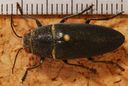
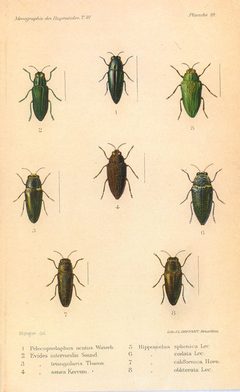
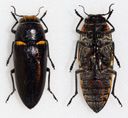
Large, robust beetles with a somewhat flattened body form. Coloration typically metallic, ranging from coppery-green to blue-black. Body shape somewhat elongate-oval. serrate. may show surface sculpturing or . Size appears substantial relative to other buprestid , based on field observations describing them as 'big buprestids'.
Habitat
Arid and semi-arid environments including desert flats, desert scrub, and canyon systems. Associated with woody vegetation, particularly leguminous shrubs and trees. Documented at elevations from low desert flats to oak woodland zones in mountain ranges. Specific microhabitats include roadside vegetation, washes, and rocky slopes with plant presence.
Distribution
Western North America and Mexico. Documented from Arizona, New Mexico, and adjacent Mexican states. records include: Arizona (Chiricahua Mountains, Santa Rita Mountains, Huachuca Mountains), and Mexico. The shows affinity for the Sonoran Desert and adjacent sky island .
Seasonality
activity observed during summer monsoon season, primarily July and August. Coincides with flowering period of legumes. Peak activity during warm, humid conditions following rainfall events.
Host Associations
- Acacia rigida - collected on foliage; observed flying and landing on this
- Acacia greggii - collected from foliage
- Prosopis glandulosa - observed on mesquite
- Mimosa dysocarpa - abundant on blooming velvetpod mimosa; mating pairs observed
Behavior
are , active during daylight hours, and highly mobile. Strong fliers; observed flying between plants and landing on foliage and flowers. Readily take when disturbed, making capture difficult. Mating pairs have been observed on host plant foliage. Adults appear to be attracted to blooming host plants, suggesting possible feeding on floral resources.
Similar Taxa
- GyascutusFormerly treated as subgenus; closely related and similar in appearance. Distinguished by antennal structure and subtle body proportions. Gyascutus also large, metallic buprestids associated with desert legumes.
- AcmaeoderaBoth are Buprestidae in same region, but Acmaeodera are notably smaller and more slender with different associations.
More Details
Taxonomic History
The was historically treated as a subgenus of Gyascutus. The two genera are now recognized as distinct but remain closely related, with some taxonomic uncertainty persisting in the literature. A 2018 field blog notes: 'There are no Hippomelas in Nevada, but several of the closely related and former subgenus Gyascutus do occur there.'
Field Recognition
Hippomelas are among the most conspicuous buprestids in their range due to large size and active . Collectors specifically target blooming Mimosa and Acacia stands for this . Hippomelas planicauda has been particularly well-documented through recent Arizona collecting trips.