
Gyascutus planicosta
(LeConte, 1858)
Species Guides
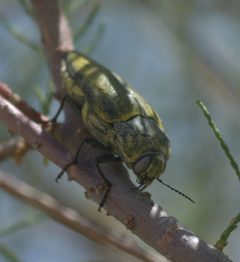
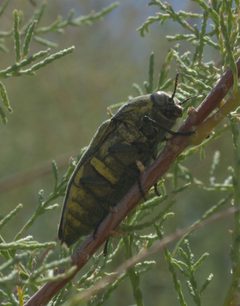
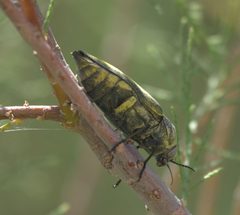
3Gyascutus planicosta is a large metallic wood-boring beetle in the Buprestidae. reach up to 50 mm in length and display brilliant metallic coloration. The occurs in the desert southwest of North America, with larvae developing in living roots of plants rather than dead wood. Three are recognized, with G. p. obliteratus occurring in western Texas and southern New Mexico.
Pronunciation
How to pronounce Gyascutus planicosta: //dʒaɪˈæskjʊtəs ˌplænɪˈkɒstə//
These audio files are automatically generated. While they are not always 100% accurate, they are a good starting point.
Identification
are distinguished by their large size (up to 50 mm), brilliant metallic blue-green coloration, and pattern of punctation on the . The is among the largest North American buprestids. Similar large desert buprestids include Lampetis drummondii and L. webbii, which share comparable size and metallic coloration but differ in details of punctation and body form. Gyascutus caelatus is another found in the same region, associated with acacias and mesquites rather than creosote.
Images
Habitat
Creosote bush scrub and desert scrub . have been observed on Larrea tridentata (creosote) and Prosopis glandulosa (mesquite). Larval development occurs in living roots of Atriplex and other asteraceous shrubs, below the soil line.
Distribution
Central America and North America. In the United States, recorded from western Texas, southern New Mexico, and southeastern Arizona (Cochise County representing the western limit). The G. p. obliteratus occurs in the El Paso, Texas area and adjacent southern New Mexico.
Host Associations
- Larrea tridentata - occurrence observed on flowers
- Prosopis glandulosa - occurrence observed on vegetation
- Atriplex - larval larvae develop in living roots
- Asteraceae - larval larvae develop in living roots of shrubs in this
Life Cycle
Larvae are restricted to living roots of shrubs, feeding below the soil line. This explains the rarity of larval collections compared to . Larvae reach approximately 50 mm in length at maturity. Development in living wood distinguishes this from many buprestids that utilize dead wood.
Behavior
are described as clumsy and relatively unalert, allowing hand-collection from vegetation. They have been observed taking from plants and can be tracked to landing sites. Adults aggregate on blooming creosote in suitable .
Similar Taxa
- Lampetis drummondiiSimilar large size (up to 50 mm) and brilliant blue-green metallic coloration. Distinguished by details of elytral punctation and larval —L. drummondii larvae develop in living wood of willows (Salix) below the soil line, not in roots of desert shrubs.
- Lampetis webbiiComparable size and metallic appearance. Much rarer than G. planicosta; larval unconfirmed but suspected to include Parkinsonia.
- Gyascutus caelatusCongeneric found in same region, associated with Vachellia constricta (white-thorn acacia) and other acacias/mesquites rather than creosote scrub.