
Gyascutus
LeConte, 1858
Species Guides
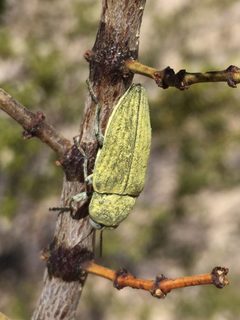
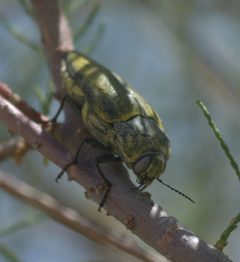
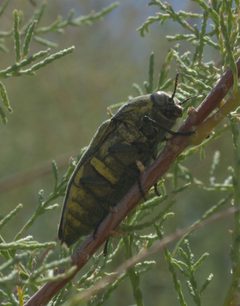
7Gyascutus is a of jewel beetles ( Buprestidae) comprising approximately 14 described distributed primarily in the southwestern United States and northern Mexico. These beetles are notable for their relatively large size among buprestids and their distinctive powdery yellow-white waxy bloom covering the , which is secreted by after and serves a thermoregulatory function in their arid . The genus includes species associated with various woody plants, particularly acacias and other leguminous trees.
Pronunciation
How to pronounce Gyascutus: /ɡaɪəsˈkjuːtəs/
These audio files are automatically generated. While they are not always 100% accurate, they are a good starting point.
Identification
Distinguished from other large buprestid by the combination of: (1) prominent yellow-white waxy bloom on (shared with some related genera but particularly well-developed in Gyascutus); (2) association with acacias and other leguminous in arid regions; (3) relatively large size and robust build; (4) or sculptured elytral surface visible beneath the bloom. Gyascutus caelatus is one of the more commonly encountered and can be recognized by its pale bloom and dark underlying coloration. Similar genera such as Hippomelas lack the dense waxy bloom and have smoother, more strongly metallic elytra.
Images
Habitat
Arid and semi-arid regions including desert flats, desert thorn-scrub, and riparian corridors in the southwestern United States and northern Mexico. Associated with woody vegetation, particularly leguminous trees and shrubs such as acacias (Acacia spp., including A. rigidula, A. greggii), mesquite (Prosopis glandulosa), and related Fabaceae. Found in areas with sandy or rocky soils at elevations from low desert to montane juniper woodlands.
Distribution
Southwestern United States (Arizona, New Mexico, Texas) and northern Mexico. Records exist from southeastern Arizona (Chiricahua Mountains, Santa Rita Mountains, Huachuca Mountains, Tombstone area), southwestern New Mexico, and western Texas. Some have more restricted ranges; for example, Gyascutus carolinensis occurs in the southeastern United States.
Seasonality
are active primarily during summer months, with peak activity from July through August coinciding with monsoon rains and flowering of plants. Activity patterns are influenced by rainfall and host plant . In Arizona, adults have been collected from late July through early August.
Host Associations
- Acacia rigidula - sweet acacia; collected on flowers and foliage
- Acacia greggii - catclaw acacia
- Prosopis glandulosa - mesquite; found on flowers and beaten from foliage
- Acacia constricta -
- Juniperus monosperma - one-seed juniper; Gyascutus carolinensis specifically associated with this
Behavior
are , active flyers that are often observed flying rapidly around trees, particularly when these are in bloom. They are extremely flighty and difficult to collect, taking immediately upon disturbance. Adults are frequently found on flowers of host plants, where they likely feed on pollen or nectar. They have been observed mating on host foliage. The waxy bloom is secreted after and is relatively durable compared to some other buprestids, persisting for some time in active adults.
Ecological Role
serve as of their plants while feeding on floral resources. Larval stages are wood-borers in living or stressed host trees, contributing to nutrient cycling and potentially serving as prey for woodpeckers and other . The represents a component of the diverse buprestid fauna characteristic of North American desert .
Human Relevance
Of minor economic importance; not considered a significant pest of forestry or agriculture. Collected by entomologists and enthusiasts due to their distinctive appearance and challenging capture. The durable waxy bloom makes preserved specimens particularly attractive. Some are indicators of healthy desert with intact plant .
Similar Taxa
- HippomelasLarge buprestids associated with acacias in similar ; distinguished by lack of dense waxy bloom, smoother and more strongly metallic , and different body proportions
- AcmaeoderaCommon sympatric buprestids; much smaller (usually <12 mm), lack waxy bloom, have more elongate bodies and different elytral sculpturing
- LampetisLarge, robust buprestids with metallic coloration; lack the distinctive pale waxy bloom of Gyascutus and typically have smoother with different color patterns
More Details
Waxy bloom characteristics
The powdery yellow-white bloom of Gyascutus is more durable than that of some tropical buprestids such as Euchroma gigantea. This durability is likely an to the arid environments these beetles inhabit, where the bloom serves a thermoregulatory function by reflecting solar radiation. The bloom can be preserved on collected specimens with careful handling.
Taxonomic history
The was established by LeConte in 1858 with Gyascutus planicosta as the type . Several species were described in the mid-20th century by Helfer and others, with additional species described by Nelson in 1988 and 2000. The genus is part of the diverse North American buprestid fauna that has been extensively studied by collectors in the southwestern United States.