
Lampetis
Dejean, 1833
Eyed Jewel Beetles
Species Guides
3- Lampetis cupreopunctata(Tamaulipan Copper-spotted Buprestid)
- Lampetis drummondi(Drummond's metallic wood-boring beetle)
- Lampetis webbii
Lampetis is a large of jewel beetles (Buprestidae) comprising nearly 300 worldwide. are typically large, conspicuous beetles with brilliant metallic coloration. The genus has a broad geographic distribution spanning North America, South America, the Middle East, and Central Asia. Larval remains poorly known for most species, with development suspected to occur in living wood below the soil line—a habit that explains the rarity of larval discoveries.
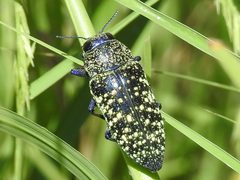
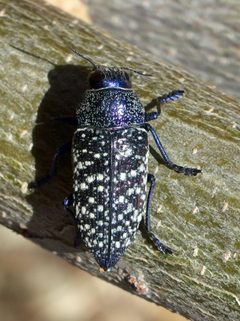
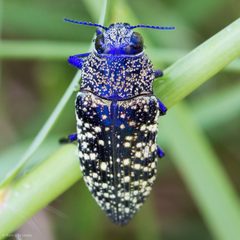
Pronunciation
How to pronounce Lampetis: //læmˈpɛtɪs//
These audio files are automatically generated. While they are not always 100% accurate, they are a good starting point.
Images
Distribution
distribution including North America (southwestern United States), South America (Argentina and broader Neotropics), the Middle East (Iraq), and Central Asia. Specific records include: Oklahoma and Texas in the United States; San Luis Province, Argentina; Basrah Province, Iraq.
Host Associations
- Ziziphus spina-christi - larval jujube trees in Iraq; specimens observed attacking this in Basrah Province
- Salix gooddingii - probable larval Goodding willow; probable for L. drummondii based on larval discovery at trunk base in Big Bend, Texas
- Bulnesia retama - plant of L. baeri and L. corinthia observed on this shrub in Encón Dunes, San Luis Province, Argentina
- Rhus aromatica - plant of L. drummondii observed perched on branches in Oklahoma and Texas
- Diospyros texana - plantpersimmon; frequently found on this in west Texas
Life Cycle
Larval development occurs in living wood, typically below the soil line at the base of trees. This subterranean habit makes larvae exceptionally difficult to locate and explains why larval stages remain undescribed for most . emerge and are active on above-ground vegetation, where they can be collected from branches of various shrubs and small trees.
Behavior
are relatively clumsy and not highly alert, allowing hand-collection from vegetation. They are often found perched on outer branches of plants. Activity patterns suggest late summer to early autumn in North American , with adults observed in August and September. Larvae create galleries in living wood at the live/dead wood interface near ground level.
Similar Taxa
- Lampetis webbiisimilar large size and appearance; distinguished by distribution and relative abundance (L. webbii rarer, more southern Arizona records)
- Polycesta deserticolasimilar large larval size in desert southwest; distinguished by breeding in dead, dry branches rather than living wood
- Gyascutus planicostasimilar large larval size; distinguished by larval restriction to living roots of Atriplex and other asteraceous shrubs
More Details
Larval description challenges
Only two in the have documented larval descriptions: L. argentata from Central Asia (develops in living roots of Haloxylon) and a probable L. drummondii from Texas. The larva of L. drummondii was identified by Mark Volkovitsh based on large size (~50 mm), narrowly V-shaped furcus on the pronotal shield, and association with elytral fragments showing characteristic punctation and brilliant blue-green coloration.
Nomenclatural note
The subgenus Spinthoptera has been used for some (e.g., Lampetis (Spinthoptera) drummondi), though its current taxonomic status varies in recent literature.
Collection methods
readily attracted to ultraviolet light in some , though moon phase and temperature affect activity. Can be beaten from vegetation or hand-picked directly from branches due to sluggish response.
Sources and further reading
- BugGuide
- Wikipedia
- GBIF taxonomy match
- iNaturalist taxon
- Catalogue of Life
- Lampetis drummondi larva? | Beetles In The Bush
- Fun with eucraniines! My hi | Beetles In The Bush
- Buprestidae type specimens at Fundación Miguel Lillo, Argentina | Beetles In The Bush
- August “jug trap” run | Beetles In The Bush
- Biology and Morphology of <I>Lampetis Mimosae</I> (Buprestidae, Coleoptera) from Iraq