
Lampetis drummondi
(Laporte & Gory, 1836)
Drummond's metallic wood-boring beetle
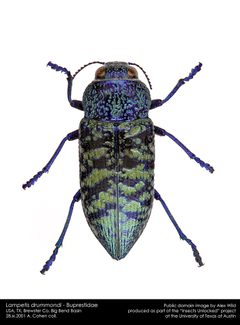
Lampetis drummondi is a large, metallic wood-boring beetle in the Buprestidae, reaching up to 50 mm in length. are brilliant blue-green in color with distinctive punctation patterns on the . The occurs in the desert southwest of North America and Central America. Adults are often found resting on small trees and shrubs, particularly persimmon (Diospyros texana) in western Texas, and are notably sluggish and easily captured by hand. The larval remained unknown until 2004, when larvae were discovered feeding in living willow (Salix gooddingii) wood at the soil line.
Pronunciation
How to pronounce Lampetis drummondi: //læmˈpiːtɪs ˈdrʌmɒndi//
These audio files are automatically generated. While they are not always 100% accurate, they are a good starting point.
Identification
Distinguished from other large North American buprestids by combination of size, coloration, and punctation pattern. Polycesta deserticola is smaller and breeds only in dead, dry branches. Gyascutus planicosta larvae are restricted to living roots of Atriplex and other asteraceous shrubs. Lampetis webbii is similar in appearance but much rarer and has different distribution; average slightly smaller. The two may co-occur in southern Arizona.
Images
Appearance
Large buprestid , up to 50 mm in length. brilliant blue-green in color with metallic luster. show characteristic pattern of punctation. Body robust and somewhat flattened typical of the . serrate. Larvae are large, white, legless with narrowly V-shaped furcus on the pronotal shield, reaching approximately 50 mm in length when mature.
Habitat
occur in desert and arid grassland environments, often in canyons and riparian areas with small trees and shrubs. Larval is living wood at or below the soil line, particularly willow (Salix gooddingii) and likely other woody . Observed in shortgrass prairie, hackberry/bumelia/juniper canyon woodland, and sand dune habitats with scattered woody vegetation.
Distribution
North America: southwestern United States (western Texas, New Mexico, Oklahoma, Arizona) and Mexico. Central America. Western distributional limit recorded as Cochise County, Arizona.
Seasonality
active late summer through early fall. Observations from Oklahoma in late August and early October. iNaturalist records from the area concentrated in September and October.
Host Associations
- Salix gooddingii - larval living wood at trunk base, below soil line
- Diospyros texana - resting siteespecially favored in western Texas; not larval
- Rhus aromatica - resting siteobserved perched on branches at dusk
Life Cycle
Larvae develop in living wood, likely feeding below the soil line on roots or lower trunk. This habit explains the extreme rarity of larval discovery despite commonness. Larvae are large, white, legless with characteristic pronotal shield . occurs within the wood. Adults emerge in late summer. Extended development with possible, as documented in related wood-boring beetles in structural timber.
Behavior
are notably sluggish and unalert, allowing easy hand collection from vegetation. Often found perched on outer branches of small trees and shrubs, especially near dusk. Not particularly wary; when approached, adults may remain stationary or move slowly rather than flying immediately. In contrast, larvae require living tissue and cannot complete development once removed from galleries.
Ecological Role
Larval feeding in living willow wood suggests role as primary wood borer in riparian and canyon . Large size indicates significant contribution. likely serve as prey for insectivorous vertebrates and . Ecological relationships otherwise poorly documented.
Human Relevance
Of interest to coleopterists due to large size, attractive coloration, and historical mystery of larval . No documented economic importance. Potential structural pest if larvae occur in timber, as suggested by related cases of prolonged larval development in construction wood.
Similar Taxa
- Lampetis webbiiSimilar appearance and size; much rarer; southern Arizona distribution; larval unknown but possibly develops in Parkinsonia florida (Blue Palo Verde)
- Polycesta deserticolaSimilar large size; develops in oak and willow but only dead, dry branches; smaller than L. drummondi
- Gyascutus planicostaSimilar larval size; restricted to living roots of Atriplex and asteraceous shrubs; different
More Details
Larval discovery
First documented larvae were collected in 2004 from a flood-uprooted Goodding willow (Salix gooddingii) in Big Bend National Park, Texas. The discovery was significant because L. drummondi is one of the most commonly encountered buprestids in the desert southwest, yet its larva had remained unknown. The larva was subsequently dissected and described with assistance from Mark Volkovitsh, a leading buprestid larval .
Taxonomic note
Sometimes placed in subgenus Spinthoptera as Lampetis (Spinthoptera) drummondi. The larva shows morphological similarity to the European Lampetis argentata, whose larvae develop in living roots of saxaul (Haloxylon), suggesting the may generally utilize living subterranean wood.