
Lampetis webbii
(LeConte, 1858)
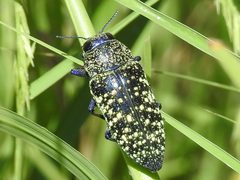
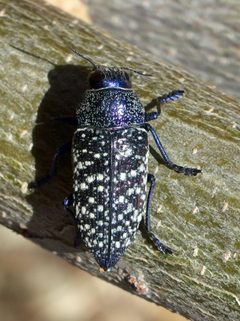
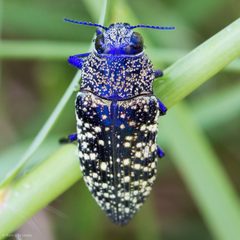
Lampetis webbii is a large metallic wood-boring beetle in the Buprestidae. reach up to 50 mm in length and display brilliant blue-green coloration. The is known from the desert southwest of North America, with records from Arizona, and is considerably rarer than its L. drummondii. Larval remains unknown, though related species in the develop in living wood below the soil line.
Pronunciation
How to pronounce Lampetis webbii: //læmˈpiːtɪs ˈwebbi.aɪ//
These audio files are automatically generated. While they are not always 100% accurate, they are a good starting point.
Identification
are distinguished from the similar and more common Lampetis drummondii by subtle differences in elytral punctation and coloration pattern. Both share the large size (up to 50 mm), robust body form, and metallic blue-green coloration characteristic of the . Definitive separation may require examination of specific structural characters.
Images
Habitat
have been collected in desert thorn-scrub and wash in southeastern Arizona. One documented collection occurred on Rhus (sumac) trees growing along wash banks, though this likely represents adult feeding or resting habitat rather than larval association. The occurs in areas dominated by woody vegetation including mesquite, acacia, and sumac.
Distribution
Recorded from southern Arizona (Cochise County and vicinity of Tombstone) and presumably ranging into adjacent regions of the southwestern United States and northern Mexico. The western distributional limit appears to be in southeastern Arizona, with the occurring more frequently in this region than farther east.
Seasonality
activity has been documented in July and August during the summer monsoon season. One collection occurred in early August following heavy rains.
Host Associations
- Rhus sp. - collection site collected on trees growing along wash banks; not confirmed as larval
Behavior
are capable of and have been observed flying to and landing on vegetation. They appear relatively alert and can be difficult to approach closely. One individual was observed flying from a Rhus tree and landing low in nearby vegetation.
Similar Taxa
- Lampetis drummondiiVery similar in size, coloration, and general appearance; distinguished by subtle differences in elytral punctation and pattern. L. drummondii is far more common and widespread throughout the desert southwest.
- Gyascutus caelatusAnother large blue-green buprestid sympatric in Arizona desert ; distinguished by different body shape and elytral sculpturing. Can occur on similar plants and in same habitats.
More Details
Larval biology
The larval form and associations of L. webbii remain completely unknown. A 1918 record attributed larvae to this from dead Parkinsonia florida (Blue Palo Verde) heartwood requires verification. Based on the known larval of the European L. argentata, which develops in living roots of Haloxylon, L. webbii may utilize living woody roots below the soil line. This would explain the extreme rarity of larval collections despite detectability.
Rarity
The is considered quite rare, with few documented collections. One experienced collector noted it as a 'highly desirable' target species and a 'first' for their collection after decades of fieldwork in the region.