
Ernobius mollis
(Linnaeus, 1758)
pine knot borer, pine bark anobiid, waney edge borer, bark borer
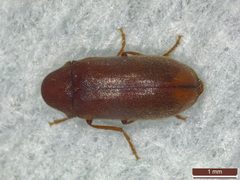
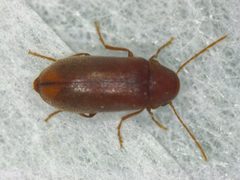
Ernobius mollis is a small wood-boring in the Ptinidae (formerly Anobiidae), commonly known as the pine knot borer. Native to northern Europe, it has been introduced to North America and is also recorded from the Azores. The develops in dead pine wood, particularly in bark and knots, and is frequently associated with processed timber. Two are recognized: the nominate E. m. mollis and E. m. espanoli from the Iberian region.

Pronunciation
How to pronounce Ernobius mollis: /ɛrˈnoʊ.bi.əs ˈmɒl.ɪs/
These audio files are automatically generated. While they are not always 100% accurate, they are a good starting point.
Identification
Ernobius mollis can be distinguished from other Ernobius by its small size and association with Pinus wood. are typical of the Ptinidae with a compact, somewhat cylindrical body form. The species may be separated from the related Anobium punctatum (common furniture beetle) by preference—E. mollis is primarily found in pine bark and knots rather than seasoned hardwoods. E. m. espanoli differs subtly in geographic distribution, being restricted to the Iberian Peninsula.
Images
Habitat
Develops in dead wood of pine (Pinus spp.), particularly in bark, knots, and waney edges of processed timber. Has been recorded from standing dead pines as well as felled and stored wood.
Distribution
Native to northern Europe; introduced to North America. Recorded from São Miguel and Terceira in the Azores. The E. m. espanoli occurs in the Iberian Peninsula.
Diet
Larvae feed on dead pine wood (Pinaceae), developing within bark, knots, and sapwood.
Host Associations
- Pinus - larval primary ; larvae develop in dead bark, knots, and wood of pine
Life Cycle
Complete with , larval, pupal, and stages. Larvae are wood-borers that tunnel through pine bark and wood, creating galleries packed with . occurs within the wood, with adults emerging through exit holes.
Behavior
are attracted to dead pine material. The is known to infest processed timber, particularly waney-edged boards with bark remnants.
Ecological Role
Decomposer of dead pine wood; contributes to nutrient cycling in pine forests and in timber storage environments.
Human Relevance
Considered a minor pest of processed pine timber, particularly when bark is present on waney edges. The 'waney edge borer' refers to its habit of infesting boards with irregular edges retaining bark. Damage is generally limited compared to more serious timber pests like Anobium punctatum.
Similar Taxa
- Anobium punctatumAlso in Ptinidae and similar size, but A. punctatum primarily attacks seasoned hardwoods and softwoods in buildings, whereas E. mollis is restricted to pine bark and knots.
- Other Ernobius speciesSeveral Ernobius share pine associations; E. mollis is distinguished by its broad distribution and preference for bark/knot rather than deeper wood.
Sources and further reading
- BugGuide
- Wikipedia
- GBIF taxonomy match
- iNaturalist taxon
- NCBI Taxonomy
- Grasshopper Collections and Survey
- Revisiting Acalypha: Integrating global knowledge and taxonomy for drug discovery | Blog
- Bug Eric: Masters of Mud: Auplopus Spider Wasps
- Season Finale | Beetles In The Bush
- THE MORPHOLOGY AND BIOLOGY OF ERNOBIUS MOLLIS L. (COLEOPTERA—ANOBIIDAE)