
Ernobiinae
Pic, 1912
death-watch and spider beetles
Tribe Guides
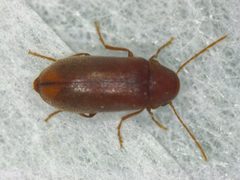
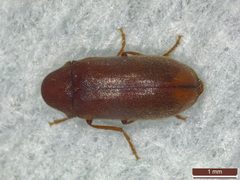
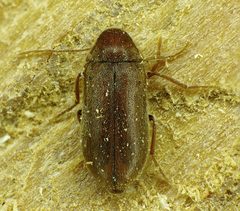
3Ernobiinae is a of beetles in the Ptinidae, containing approximately 8 and at least 90 described . Members are commonly known as death-watch and spider beetles. The subfamily was historically classified within Anobiidae, but is now placed in Ptinidae following taxonomic revision.
Pronunciation
How to pronounce Ernobiinae: /ɛrˈnoʊ.bi.aɪ.niː/
These audio files are automatically generated. While they are not always 100% accurate, they are a good starting point.
Identification
Ernobiinae can be distinguished from related by their association with the Ptinidae. The subfamily contains such as Xestobium (which includes the common death-watch beetle), Ernobius, Episernus, Ozognathus, Microzogus, Paralobium, Utobium, and Xarifa. Some sources also include Ochina.
Images
Habitat
vary by and . At least one species, Ozognathus cornutus, has been documented in woody galls formed by other insects, as well as in decaying organic material including dried fruits, small wood shavings, and insect excrements in galleries made by woodboring species.
Distribution
Worldwide distribution with at least one (Ozognathus cornutus) native to North America and naturalized in Italy (first recorded 2011).
Diet
At least some members are saproxylophagous. Ozognathus cornutus feeds on decaying tissues within galls, dried fruits, small wood shavings, and insect excrements in galleries made by other woodboring . Broader dietary habits for the as a whole are not documented.
Behavior
Ozognathus cornutus has been observed living as a successor in galls formed by other insects, preferring woody and conspicuous galls over alternative substrates. Whether this is characteristic of the is unknown.
Ecological Role
Some may act as successors in pre-existing insect galls. Ozognathus cornutus has been reported to have a potential role as a pest of dried fruits and vegetables, though galls may act as a natural barrier limiting damage to these substrates.
Human Relevance
Some have potential economic significance as pests of stored products. Ozognathus cornutus represents an species that has naturalized in Europe.
Similar Taxa
- AnobiinaeFormerly classified together in the Anobiidae; now separated into Ptinidae with Ernobiinae
- DryophilinaeAlso transferred from Anobiidae to Ptinidae in the same taxonomic revision
More Details
Taxonomic History
Ernobiinae was formerly classified within the Anobiidae, but following revision, Anobiidae was split and the family name Ptinidae was reinstated to include Ernobiinae along with Anobiinae, Dryophilinae, and several other .
Notable Genera
Xestobium includes of economic importance. Ozognathus cornutus has been studied for its invasion in Europe.