
Ozognathus
LeConte, 1861
death-watch beetles, spider beetles
Species Guides
2- Ozognathus cornutus(Acorn Anobiid)
- Ozognathus floridanus
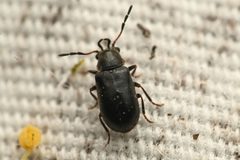
Ozognathus is a of beetles in the Ptinidae, commonly referred to as death-watch and spider beetles. The genus contains at least 11 recognized native to the Americas. One species, Ozognathus cornutus, has become established as an species in Europe and the Mediterranean region, where it colonizes woody galls and decaying organic matter. The genus is taxonomically placed in the Ernobiinae (or historically Anobiinae), reflecting its close relationship to other wood-associated beetles.
Pronunciation
How to pronounce Ozognathus: /ˌoʊzoʊˈnæθəs/
These audio files are automatically generated. While they are not always 100% accurate, they are a good starting point.
Images
Habitat
in this occupy environments containing decaying plant material. Ozognathus cornutus has been documented in both man-made and natural , including within woody galls formed by gall wasps and , as well as in association with dried fruits, small wood shavings, insect excrements, and galleries created by other woodboring insects. In the Mediterranean region, the species has been found on Eucalyptus species.
Distribution
Native to the Americas (Nearctic and ). Ozognathus cornutus has been introduced and naturalized in Europe and the Mediterranean region, with confirmed records from Italy (first recorded 2011), Greece (Rhodes Island), Cyprus, Sardinia, France, Switzerland, Britain, Latvia, and Israel.
Diet
Saproxylophagous. Ozognathus cornutus feeds on decaying tissues within conspicuous galls, dried fruits, small wood shavings, and insect excrements in galleries made by other woodboring .
Host Associations
- Psectrosema tamaricis - gall successorDiptera: Cecidomyiidae; 23% gall occupancy rate in Italy
- Plagiotrochus gallaeramulorum - gall successorHymenoptera: Cynipidae; 76.9% gall occupancy rate in Italy
- Andricus multiplicatus - gall successorHymenoptera: Cynipidae; 43.6% gall occupancy rate in Italy
- Synophrus politus - gall successorHymenoptera: Cynipidae; 61.1% gall occupancy rate in Italy
- Asphodelus ramosus - plantNew record from Greece/Cyprus
- Schinus terebinthifolia - plantNew record from Greece/Cyprus
- Schinus molle - plantNew record from Greece/Cyprus
- Vachellia farnesiana - plantNew record from Greece/Cyprus
- Eucalyptus spp. - plant trees in Cyprus
Behavior
Ozognathus cornutus acts as a successor , colonizing pre-existing galls formed by other insects rather than inducing its own. The species shows strong preference for woody, conspicuous galls over alternative substrates, which may function as a natural barrier limiting its spread to economically important materials like stored dried fruits and vegetables. Gall occupancy rates vary by species, with higher rates observed in cynipid galls on oaks compared to cecidomyiid galls.
Ecological Role
Saproxylophagous decomposer that contributes to breakdown of decaying plant tissues and insect excrements within galls. The facilitates nutrient cycling in gall microhabitats. No adverse impacts on native biodiversity have been documented in invaded regions. Galls appear to play an important ecological role in speeding up the naturalization process of this species.
Human Relevance
Ozognathus cornutus represents a potential pest of dried fruits and vegetables, though its strong preference for woody galls may limit economic damage. No phytosanitary measures have been applied against this in Europe. The spread of this illustrates how specific microhabitats (insect galls) can facilitate biological invasions.
Similar Taxa
- Other Ptinidae genera (e.g., Ptinus, Lasioderma)Similar habits as stored product pests and wood-associated beetles; Ozognathus is distinguished by its specific association with pre-formed galls and its Nearctic origin for O. cornutus
- Other Ernobiinae generaShared placement and saproxylophagous ; specific associations and geographic distribution differentiate Ozognathus
More Details
Taxonomic placement
The placement of Ozognathus varies in literature: Ernobiinae (per some modern treatments and the Italian study) versus Anobiinae (per Greek and Cyprus studies). This reflects ongoing taxonomic revisions within Ptinidae/Anobiidae.
Species diversity
While Wikipedia reports 11 recognized , iNaturalist notes at least three described species. The -level account here focuses primarily on O. cornutus due to available documentation; other species likely share the New World distribution but lack detailed study.
Sources and further reading
- BugGuide
- Wikipedia
- GBIF taxonomy match
- iNaturalist taxon
- First record of the Nearctic Ozognathus cornutus (LeConte, 1859) (Coleoptera: Ptinidae: Anobiinae) in Cyprus
- Naturalization and spread of the alien species Ozognathus cornutus (LeConte, 1859) (Coleoptera: Ptinidae: Ernobiinae) in Italy
- Knowing no limits: First record of Ozognathus cornutus (Coleoptera: Ptinidae: Anobiinae) in Greece, including new host-plant records