
Dermestes sardous
Küster, 1846
Dermestes sardous is a of hide beetle in the Dermestidae, a group of scavengers important as stored product pests, recyclers, and forensic tools. Like other members of the Dermestes, this species is associated with carrion and dried animal remains. The species is known from North America, including the conterminous United States. As part of the Dermestinae, it shares the general characteristics of the genus: elongated body form, clubbed , and association with decomposing animal matter.
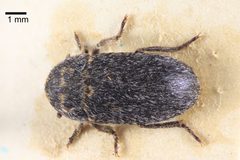
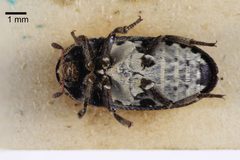
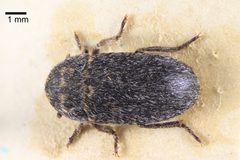
Pronunciation
How to pronounce Dermestes sardous: /dɛrˈmɛstɛs ˈsɑrdʊs/
These audio files are automatically generated. While they are not always 100% accurate, they are a good starting point.
Identification
-level identification of Dermestes sardous requires examination of subtle morphological characters, as many Dermestes species appear nearly identical. Twelve species of Dermestes are recorded from Colorado alone, with similar species including D. marmoratus, D. talpinus, and D. frischii. Definitive identification typically requires detailed examination of male genitalia or other microscopic characters. are generally black with variable patterns; D. talpinus, for example, has gold or coppery scales on the pronotum and silvery scales on the , but whether D. sardous shares this pattern is not documented in available sources.
Images
Habitat
Associated with carrion and dried animal remains, including bones in advanced stages of decomposition. Based on -level , likely found in terrestrial environments where vertebrate carcasses occur, including grasslands, ranchlands, and other open . Has been observed on coyote scat containing fur, suggesting flexibility in exploiting concentrated animal protein sources.
Distribution
North America, including the conterminous United States. Distribution records indicate presence in the conterminous 48 United States.
Diet
Scavenger on dried animal products, including remains of vertebrate carcasses. Based on -level , and larvae feed on dried flesh, skin, connective tissue, fur, and feathers. Has been observed on coyote scat, indicating use of concentrated animal protein sources.
Life Cycle
Complete with , larval, pupal, and stages. Based on related Dermestes , larvae are covered in long hairs and undergo multiple (typically 5-6 instars) before pupating in a protected location. Larvae may wander in search of sites or additional food sources.
Behavior
Scavenging focused on locating and consuming dried animal remains. Like other dermestids, likely uses olfactory cues to locate carrion resources. Larvae are mobile and may disperse from food sources to find sites.
Ecological Role
recycler, contributing to decomposition of vertebrate remains and nutrient cycling. As a scavenger, helps reduce accumulation of carrion in terrestrial environments.
Human Relevance
Potential stored product pest or nuisance given -level economic importance, though specific impacts of D. sardous are not documented. Related species in the are significant pests of cured meats, dry pet food, taxidermy mounts, and other dried animal products. Some Dermestes species are used in and by natural history museums for skeleton cleaning.
Similar Taxa
- Dermestes marmoratusCommon carrion in western North America with similar size (10-13 mm) and silvery-gray scaled appearance; requires detailed examination to distinguish
- Dermestes talpinusHide and Tallow Beetle with distinctive gold/coppery pronotal and silvery elytral scales; similar size and use on carrion
- Dermestes frischiiFringed Dermestid with similar general appearance and carrion association; identification requires microscopic examination
- Dermestes lardariusLarder , a well-known stored product pest with distinctive yellowish band across ; more commonly associated with human food stores than D. sardous appears to be
More Details
Taxonomic Context
Dermestes sardous belongs to Dermestinae, one of six subfamilies recognized in the comprehensive 2022 phylogenetic analysis of Dermestidae by Zhou et al. This study, based on 477 , established a robust molecular framework for the but did not resolve all species-level relationships.
Identification Challenges
The Dermestes presents significant identification challenges, with many requiring examination of male genitalia or other subtle characters. The statement by Eric that 'I cannot readily conclude what species are involved here' when examining Colorado Dermestes specimens illustrates the difficulty of field identification in this group.
Data Limitations
Specific information on Dermestes sardous is sparse in published literature. Most available information is inferred from -level or from studies of related . The 148 iNaturalist observations suggest it is documented but not well-studied relative to economically important relatives like D. lardarius or D. maculatus.