
Dermestes marmoratus
Say, 1823
common carrion beetle
Dermestes marmoratus, commonly known as the common carrion , is a of carpet beetle in the Dermestidae. It is found in North America, with records from southern California through the southwest, southern Rocky Mountains, and Great Plains states. The species is associated with carrion and bones in advanced stages of decomposition, where it feeds on dried animal remains.
Pronunciation
How to pronounce Dermestes marmoratus: //dɛrˈmɛstiːz ˌmɑrməˈreɪtəs//
These audio files are automatically generated. While they are not always 100% accurate, they are a good starting point.
Identification
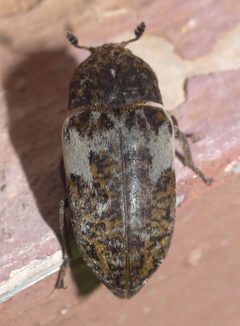
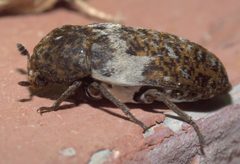
The silvery-gray scaled appearance on a black body distinguishes Dermestes marmoratus from many other beetles. However, positive identification to within the Dermestes is challenging; twelve species of Dermestes are recorded from Colorado alone, many of which appear nearly identical. Examination of patterns and other subtle morphological characters may be required for definitive identification.
Images
Habitat
Found in association with carrion, particularly bones in advanced stages of decomposition where flesh is largely desiccated. Has been observed on dry bones of large mammals and in coyote scat containing fur from prey animals.
Distribution
North America. Recorded from southern California through the southwestern United States, southern Rocky Mountains, and Great Plains states. Specific records include Alberta, British Columbia, and Manitoba in Canada.
Diet
Feeds on dried animal products, including desiccated flesh, skin, and other remains from carcasses in advanced decomposition stages.
Behavior
are attracted to carrion remains, particularly dry bones. The has been observed in with other carrion-associated beetles, appearing after flies have lost interest in remains.
Ecological Role
Contributes to decomposition and nutrient cycling as a scavenger on carrion. Part of the of insects that process animal remains in terrestrial .
Human Relevance
Related to used in natural history museums for cleaning flesh from skeletons, though D. marmoratus itself is not specifically documented for this purpose. Not known as a significant stored product pest compared to some .
Similar Taxa
- Dermestes lardariusThe larder beetle is a related in the same that occurs indoors as a stored product pest; it has a distinct yellowish band across the rather than silvery-gray mottling.
- Dermestes maculatusThe hide beetle is used in forensics and taxidermy; -level distinction within Dermestes requires careful examination due to similar appearances.
- Thanatophilus lapponicusThe Northern Carrion Beetle is superficially similar in size and carrion association but belongs to Silphidae; it has a hairy rather than scaled appearance.
More Details
Taxonomic Note
iNaturalist lists Dermestes marmoratus as a 'complex' or group rather than a single species, suggesting possible taxonomic uncertainty or cryptic diversity within this lineage.
Identification Challenges
A 2014 field observation noted difficulty distinguishing D. marmoratus from D. fasciatus in the field; expert examination may be required for definitive identification.