
Dermestes lardarius
Linnaeus, 1758
larder beetle, moisture bug, bacon beetle
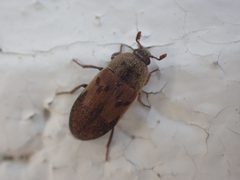
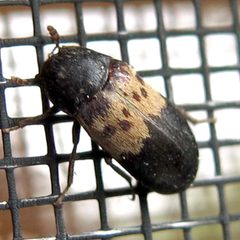
Dermestes lardarius, commonly known as the larder or bacon beetle, is a pest of stored animal products. measure 7–9 mm and are distinguished by a broad yellowish band with three black dots across dark brown . The completes its in 40–50 days under optimal conditions but typically produces one per year. Both larvae and adults feed on dried meats, pet food, hides, feathers, cheese, and museum specimens.
Pronunciation
How to pronounce Dermestes lardarius: //dɛrˈmɛs.tiːz lɑrˈdɛə.ri.əs//
These audio files are automatically generated. While they are not always 100% accurate, they are a good starting point.
Identification
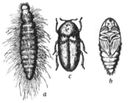
are distinguished from other household beetles by the combination of short clubbed and the characteristic yellow-banded with three black spots. The larva is recognized by its dense covering of long hairs and the pair of conspicuous curved spines at the rear. Separated from Dermestes maculatus by the more strongly curved larval urogomphi and the distinct elytral pattern.
Images
Habitat
Indoors: pantries, storage facilities, museums, and residences where dried animal products are stored. Outdoors: overwinter in protected locations such as under bark or in leaf litter. Larvae require solid substrates (wood, cork, plaster) for .
Distribution
. Established worldwide in association with human food storage. Native to the Palearctic region.
Seasonality
overwinter outdoors in protected areas, entering buildings during spring and early summer. Active indoors year-round when food is available. One per year is typical, though the can complete in 40–50 days under favorable conditions.
Diet
Dried animal products including cured meats, fish, pet food, hides, feathers, cheese, and museum specimens (dried insects, taxidermy). Will consume plant material high in protein, such as grain. Both larvae and feed on the same materials.
Life Cycle
Females lay approximately 135 in clutches of 6–8 near or within food sources. Eggs hatch in about 12 days. Larvae undergo 5 (males) or 6 molts (females), lasting 35–80 days depending on food availability. Mature larvae bore into hard substrates to pupate. emerge after approximately 15 days and may live up to 18 months. occurs in the adult stage.
Behavior
are capable fliers. Larvae may wander in search of new food sources or sites. Both stages are attracted to accumulations of dead insects in light fixtures and to carcasses of rodents within wall voids.
Ecological Role
Scavenger. In natural settings, contributes to decomposition of animal remains. In human environments, acts as a pest of stored products.
Human Relevance
Significant pest of stored food and museum collections. Historically competed seriously with humans for stored food prior to refrigeration; now considered a nuisance pest. Used in taxidermy and forensic contexts (related in same ). Prevention through proper food storage in sealed containers is the primary management strategy. Cedar chests provide effective protection for woolens and furs.
Similar Taxa
- Dermestes maculatusSimilar size and habitus; distinguished by less strongly curved larval urogomphi and different elytral pattern (mottled gray and black without distinct yellow band)
- Trogoderma variabile (warehouse beetle)Also a dermestid pest of stored products; smaller (2–3 mm), more rounded body, with variable pattern of brown, black, and white
- Attagenus unicolor (black carpet beetle)Larval form similar but is uniformly black or dark brown without elytral band; belongs to different (Attageninae)
More Details
Historical significance
Prior to widespread refrigeration, D. lardarius was a serious competitor for stored food resources. The 'larder ' derives from its association with food storage rooms ('larders').
Forensic and taxidermy applications
While D. lardarius itself is primarily a pantry pest, related in the Dermestes (particularly D. maculatus) are widely used to clean flesh from bones in museum preparation and .
Sources and further reading
- BugGuide
- Wikipedia
- GBIF taxonomy match
- iNaturalist taxon
- NCBI Taxonomy
- Bug Eric: Larder Beetle
- Bug Eric: Beetles from Bones
- New Analysis Refines Taxonomy of Dermestid Beetles
- Newest Blog Carnival: House of Herps | Beetles In The Bush
- Bug Eric: Book Review: Beetles of Eastern North America
- Bug Eric: Beat The Winter Blues With An Indoor Bug Hunt