
Dermestes talpinus
Mannerheim, 1843
hide and tallow dermestid
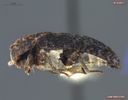
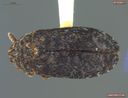
Dermestes talpinus, commonly known as the hide and tallow dermestid, is a of carpet beetle in the Dermestidae. It is native to North America and has been documented from dry bones and carrion in advanced stages of decomposition. The species is smaller than many and can be distinguished by its distinctive pattern: gold or coppery scales on the pronotum and silvery scales on the .

Pronunciation
How to pronounce Dermestes talpinus: /dɛrˈmɛstɛs tælˈpaɪnəs/
These audio files are automatically generated. While they are not always 100% accurate, they are a good starting point.
Identification
Difficult to distinguish from other Dermestes without close examination. Twelve species of Dermestes are recorded from Colorado alone, many appearing nearly identical. D. talpinus is smaller than D. marmoratus and lacks the more uniform silvery-gray scaling of that species. The gold/coppery pronotal and silvery elytral scales provide the most reliable visual cue. Definitive identification requires examination of microscopic characters.
Images
Appearance
Habitat
Associated with dry bones and carcasses in advanced stages of decomposition. Has been found on mammal bones where flesh is largely absent. Occurs in both natural outdoor settings and situations where animal remains accumulate.
Distribution
North America. Documented from Canada (Alberta, British Columbia, Manitoba) and the United States. Observations suggest presence in the Rocky Mountain region and Great Plains.
Diet
Scavenger on dried animal matter. Has been observed on bones where it likely consumes residual dried tissues, connective material, and associated organic debris.
Behavior
have been found on dry bones alongside other dermestid . Like other Dermestes, likely active in seeking carrion remains by olfactory detection of decomposition compounds.
Ecological Role
Contributes to decomposition and nutrient cycling as a scavenger on animal remains. Part of the successional fauna that processes carcasses after initial decomposition stages.
Human Relevance
Potential nuisance in situations involving stored animal products or accumulated animal remains. Not among the most economically significant stored product pests in the , but may occur in similar contexts.
Similar Taxa
- Dermestes marmoratusLarger size (10-13 mm vs. smaller D. talpinus); uniform silvery-gray covering body rather than bicolored coppery-silver pattern
- Dermestes lardariusIndoor pest of cured meats and stored products; broader yellow band across rather than silvery ; not typically associated with outdoor carrion
- Dermestes maculatusLarger hide beetle used in and museum skeleton preparation; different pattern and size
More Details
Taxonomic Uncertainty in Field Identification
A 2014 field observation from Colorado noted difficulty in conclusively identifying D. talpinus from similar , with the observer stating 'I have decided I cannot readily conclude what are involved here.' This reflects the broader challenge of identifying Dermestes species without microscopic examination.
Forensic Context
Dermestes including D. talpinus are part of the faunal on carcasses. They arrive after initial decomposition when remains are dry, contributing to the final cleaning of bones. This makes them relevant to for estimating postmortem intervals in later decomposition stages.