
Dermestes frischii
Kugelann, 1792
Fringed Larder Beetle
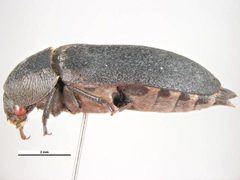
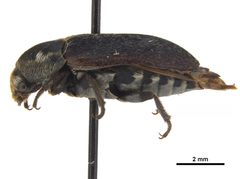
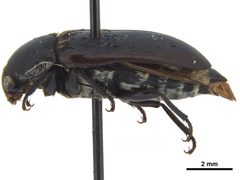
Dermestes frischii is a hide beetle in the Dermestidae, 6–9.5 mm long, black to dark brown with yellowish-white hairs on the pronotum sides. It is a significant pest of stored animal products including dried meat, fish, cheese, fur, and leather, and also damages wood, cork, and plaster when seeking sites. The is widely used in to estimate post-mortem intervals, particularly for corpses in hot, dry conditions where it colonizes remains during advanced decay stages. Males are distinguished from females by a tuft of black-brown hairs on the fourth abdominal sternite.
Pronunciation
How to pronounce Dermestes frischii: //dɛrˈmɛstɛs ˈfrɪski.aɪ//
These audio files are automatically generated. While they are not always 100% accurate, they are a good starting point.
Identification
Distinguished from Dermestes maculatus by the disrupted pale band on the larval prothorax (continuous in D. maculatus). differ from D. lardarius by lacking the broad yellowish band across the . Males are separated from females by the presence of a tuft of black-brown hairs on the fourth abdominal sternite. The yellowish-white hairs on the pronotum sides help distinguish it from some .
Images
Habitat
Associated with decomposing animal remains, carrion, and stored animal products. In natural settings, occurs on dried carcasses and bones. In human environments, infests storage facilities for dried meat, fish, cheese, fur, leather, and other animal-derived materials. Larvae bore into wood, cork, and plaster to create chambers.
Distribution
Palearctic region including Europe, tropical Africa, the Near East, North Africa, and East Asia; introduced to the Nearctic. In Europe recorded from Albania, Bosnia and Herzegovina, Bulgaria, Corsica, Croatia, Czech Republic, Denmark, European Turkey, Finland, France, Germany, Greece, Hungary, Italy, Kaliningrad, Moldova, North Macedonia, Norway (doubtful), Poland, Russia, Sardinia, Sicily, Slovakia, Spain, Sweden, Ukraine, and Yugoslavia.
Seasonality
females begin -laying in spring. Development rate and number of larval instars vary with temperature: 5–9 instars at lower temperatures, fewer at higher temperatures. Multiple possible annually under favorable warm conditions.
Diet
Larvae and feed on dried animal products including carrion, dried meat, dried fish, cheese, fur, and leather. In forensic contexts, colonizes corpses during active and advanced decay stages when dry protein-rich tissues remain.
Life Cycle
Females lay 40 to over 400 during approximately 2 months, depositing them on animal-derived food materials. Eggs hatch in 5–9 days. Larvae pass through 5–9 instars depending on temperature, with faster development and fewer instars at 26°C compared to 23°C. Larvae eventually stop feeding and seek shelter within substrate to pupate. Pupal stage lasts approximately 10 days. Total development from egg to takes approximately 60 days at 23°C and 38 days at 26°C under laboratory conditions.
Behavior
Males are attracted to volatile organic compounds from active and advanced decay stages of cadavers, while females show no behavioral preference for decomposition stage. Both sexes show strongest electrophysiological antennal responses to advanced decay odors. Larvae bore into wood, cork, and plaster to create chambers, causing damage to non-food materials.
Ecological Role
Necrophagous decomposer contributing to breakdown of animal remains; part of entomofaunal on carcasses, colonizing during later decomposition stages when tissues are desiccated. Serves as forensic for estimating post-mortem intervals, particularly in hot, dry conditions unfavorable to fly larvae.
Human Relevance
Significant pest of stored animal products causing economic damage to dried meat, fish, cheese, fur, leather, and related goods. Damage extends to wood, cork, and plaster through larval boring . Widely employed in to estimate post-mortem intervals; particularly useful for corpses in hot, dry environments. Also used in taxidermy and museum specimen preparation to clean flesh from bones.
Similar Taxa
- Dermestes maculatusLarvae similar but D. frischii has disrupted pale band on prothorax while D. maculatus has continuous band; both used in forensics but D. frischii develops faster at higher temperatures
- Dermestes lardarius D. lardarius has prominent broad yellowish band across , absent in D. frischii; both are stored product pests but D. lardarius more commonly associated with cured meats and bacon
- Dermestes undulatusOften found colonizing corpses together with D. frischii; D. frischii develops faster and with fewer instars at comparable temperatures
More Details
Forensic entomology significance
Particularly valuable for estimating post-mortem intervals in hot, dry conditions where fly larvae are less successful. May colonize corpses alone or with Dermestes undulatus.
Temperature-dependent development
Development rate strongly influenced by temperature: at 20°C takes 63.5 days, at 25°C 37.6 days, at 30°C 26.4 days, and at 35°C 22.8 days from to . Higher temperatures reduce number of larval instars.
Sources and further reading
- BugGuide
- Wikipedia
- iNaturalist taxon
- NCBI Taxonomy
- Bug Eric: More Beetles from Bones
- Bug Eric: Larder Beetle
- Bug Eric: What's in Dat Scat?
- Bug Eric: Beetles from Bones
- New Analysis Refines Taxonomy of Dermestid Beetles
- Bug Eric: A Carrion Beetle That Isn't?
- Effects of Different Temperatures on the Development of Dermestes Frischii and Dermestes Undulatus (Coleoptera, Dermestidae): Comparison Between Species
- Behavioral and Electrophysiological Responses of the Fringed Larder Beetle Dermestes frischii to the Smell of a Cadaver at Different Decomposition Stages