
Dermestes undulatus
Brahm, 1790
carpet beetle, hide beetle
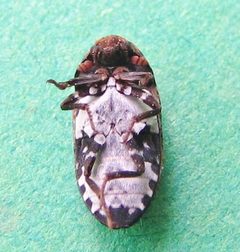
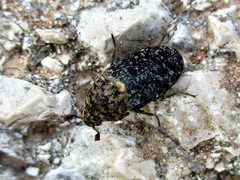
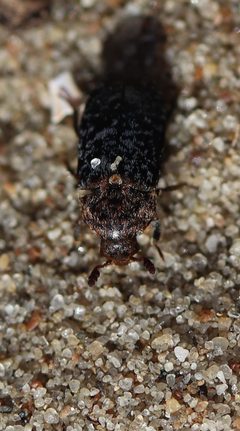
Dermestes undulatus is a hide beetle in the Dermestidae. It has forensic importance due to its of dried remains. Development is temperature-dependent, with faster development at higher temperatures. The occurs in both North America and Europe, and is considered scarce in the United Kingdom where it was recently rediscovered in Wales.
Pronunciation
How to pronounce Dermestes undulatus: //dɛrˈmɛstɛs ˌʊndʊˈleɪtəs//
These audio files are automatically generated. While they are not always 100% accurate, they are a good starting point.
Identification
Dermestes undulatus belongs to subgenus Dermestinus alongside D. murinus. Differentiation from D. murinus requires careful examination. Male genitalia structure is used for definitive identification in taxonomic studies.
Images
Distribution
North America; Europe; United Kingdom (scarce, with recent rediscovery from Flat Holm island in southern Wales); Palaearctic region including North Africa and Kazakhstan.
Life Cycle
Developmental time decreases with increasing temperature. At 23°C, total averages 50.6 days; at 26°C, 36.2 days. Larvae undergo 4–6 at 23°C, reduced to 4–5 molts at 26°C.
Ecological Role
Has been observed as a scavenger on dried animal remains.
Human Relevance
Forensic importance: and larvae colonize dried remains and can be used to assess post-mortem interval (PMI). Developmental timing data at different temperatures provides reference for forensic calculations.
Similar Taxa
- Dermestes murinusBoth belong to subgenus Dermestinus and require careful differentiation; D. undulatus distinguished by specific morphological features
- Dermestes frischiiSimilar developmental and forensic utility; D. undulatus develops faster at higher temperatures and undergoes fewer larval
Sources and further reading
- BugGuide
- Wikipedia
- GBIF taxonomy match
- iNaturalist taxon
- NCBI Taxonomy
- Bug Eric: Larder Beetle
- Bug Eric: More Beetles from Bones
- Bug Eric: What's in Dat Scat?
- Bug Eric: Beetles from Bones
- New Analysis Refines Taxonomy of Dermestid Beetles
- Bug Eric: A Carrion Beetle That Isn't?
- Dermestes undulatus Brahm rediscovered in Wales – and its differentiation from Dermestes murinus Linnaeus (Coleoptera: Dermestidae)
- Effects of Different Temperatures on the Development of Dermestes Frischii and Dermestes Undulatus (Coleoptera, Dermestidae): Comparison Between Species
- The Palaearctic <i>Dermestes undulatus</i> Brahm 1790 (Coleoptera: Dermestidae: Dermestinae) species complex: descriptions of neotype and three new species