
Trox terrestris
Say, 1825
Hide beetle, Hide and tallow beetle
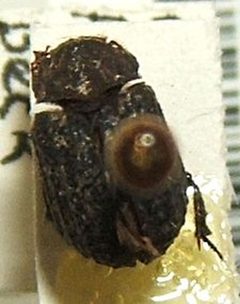
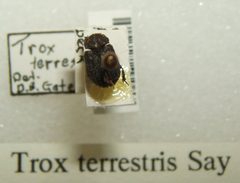
Trox terrestris is a hide beetle in the Trogidae, closely allied to scarab beetles. The has been reclassified under Glyptotrox terrestris in some taxonomic treatments. These beetles specialize in consuming dried animal remains, including skin, hair, feathers, and connective tissue during the final stages of carcass decomposition. They are known for their cryptic appearance and .
Pronunciation
How to pronounce Trox terrestris: /ˈtrɔks tɛˈrɛstrɪs/
These audio files are automatically generated. While they are not always 100% accurate, they are a good starting point.
Identification
Distinguished from other carrion beetles by its small size, rough sculptured texture, and habit of being caked in debris. Differs from Dermestidae (skin beetles) by more robust build and association with very dry remains rather than wet or greasy carrion. Separation from other Trox requires examination of specific sculptural details on the pronotum and .
Images
Habitat
Found in association with dried animal remains, including mummified carcasses, bones with dried tissue, and coyote scat containing undigested hair. Occurs in open spaces, prairies, and ranchlands where mammal remains accumulate.
Distribution
Recorded from eastern and southeastern United States: Florida, Indiana, Maryland, Massachusetts, Mississippi, and South Carolina.
Seasonality
Active during spring; observed in April in Colorado. Timing corresponds with availability of dried carcasses in advanced decomposition.
Diet
and larvae feed on dried skin, hair, feathers, fur, connective tissue, and other keratinous materials from decomposed animal remains. Has been observed on coyote scat containing undigested prey hair.
Life Cycle
Larval development occurs within dried remains. Specific details of -laying and sites are not documented for this .
Behavior
Exhibits (death-feigning) when disturbed, freezing in a rigid, random posture so convincingly that specimens are easily dismissed as dead. and larvae burrow within dried remains.
Ecological Role
decomposer of dry animal remains, processing keratinous materials during final stages of carcass decomposition. Contributes to nutrient cycling by breaking down recalcitrant organic matter that resists other decomposers.
Human Relevance
Occasional nuisance when attracted to animal remains near human habitation. Generally harmless to living humans, livestock, and stored products.
Similar Taxa
- Trox sonoraeSimilar size, , and ; both are small hide beetles in advanced decomposition stages. T. sonorae is western in distribution.
- Dermestes talpinusOverlaps in carrion but Dermestes has distinct gold or coppery on pronotum and silvery scales on , and feeds on wetter remains.
More Details
Taxonomic note
Trox terrestris Say, 1825 is treated as a synonym of Glyptotrox terrestris in some modern classifications, though both names appear in current use.