
Micromalthus debilis
LeConte, 1878
Telephone-pole Beetle
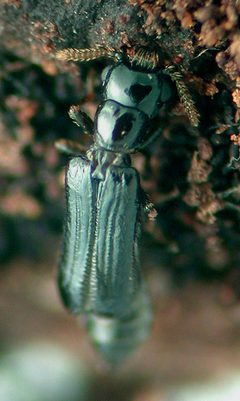
Micromalthus debilis is a small native to eastern North America and the sole living representative of the Micromalthidae, often considered a 'living fossil'. The exhibits one of the most unusual reproductive strategies in Coleoptera: obligate , where occurs exclusively through parthenogenetic female larvae without production of fertile . Adults are , sterile, and rarely encountered in nature; they can be artificially induced through heat treatment but cannot reproduce. The species is associated with decaying wood and fungal near-red-rot .
Pronunciation
How to pronounce Micromalthus debilis: /ˌmaɪ.kroʊˈmæl.θəs ˈdɛb.ɪ.lɪs/
These audio files are automatically generated. While they are not always 100% accurate, they are a good starting point.
Identification
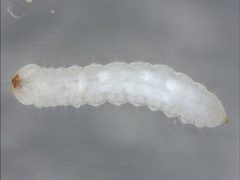
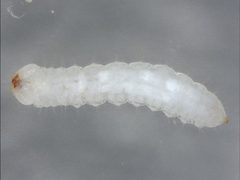
Micromalthus debilis is distinguished from all other North American beetles by its unique combination of features: extremely small size (approximately 2.5–3.5 mm), elongate body form, and reduced wing venation. , when encountered, show pronounced with females greatly outnumbering males (approximately 1000:59). Larvae are the primary life stage observed; first instar larvae are active and mobile (-like), while later instars become and wood-boring. The is most readily identified by its reproductive —no other North American reproduces exclusively through larval .
Images
Habitat
Larvae bore into decaying wood, particularly wood associated with fungal near-red-rot conditions. Colonies occupy small wood volumes, typically around 25 cm³. The is found in moist, decaying hardwoods and softwoods where fungal degradation is advanced but not complete.
Distribution
Native to eastern North America, with records from the eastern United States. A single record from Central America exists, though the is generally considered Nearctic in distribution. Distribution records in GBIF also indicate presence in Africa, Caribbean, Europe and Northern Asia (excluding China), Middle America, and North America, though these may represent introduced or data artifacts.
Diet
Larvae feed on wood infested with fungi, specifically associated with near-red-rot fungal decay. The simplified of apparently play no role in food uptake.
Life Cycle
Obligately paedogenetic: reproduces exclusively by larval thelytoky (parthenogenetic by female larvae). Under natural conditions, no fertile stage is produced. Adults are and sterile, representing a 'ghost' of the ancestral sexual . First instar larvae are active and mobile (-like); later instars become wood-borers. Reproductive larvae are capable of producing offspring directly without passing through pupal or adult stages. Male larvae are rare developmental relics that normally die as larvae. Heat treatment (55°C) can artificially induce adult development but causes severe larval mortality (approximately 1 in 315 larvae survive) and produces adults with severe developmental including reduced or absent reproductive organs. Adults are short-lived: females approximately 6 days, males approximately 13 hours. Exhibits , uni-oviparity for males, poly-viviparity for females, and internal/external matriphagy (offspring consume the mother).
Behavior
Heat-induced display sex-role reversal: females initiate mating, compete aggressively for access to males, and actively mount males (up to 5 females may pile onto one male simultaneously). Females prefer unrelated males from different patches and reject related males from the same patch, indicating outbreeding . Females engage in female-female mounting and physical fights when competing for preferred unrelated males. Adults emerge synchronously within a 45-minute window. Females move in groups, constantly and touching . Males display the immediately upon but are generally unfit and incapacitated.
Ecological Role
Larvae contribute to wood decomposition through their association with fungal near-red-rot in decaying wood. As a specialized xylobiont, the plays a role in the breakdown of lignified plant material in forest .
Human Relevance
Of scientific interest as a 'living fossil' and for its extraordinarily unusual reproductive . The has been used as a model for studying evolutionary transitions between sexual and , the evolution of , and the effects of endosymbionts on reproduction. The 'telephone-pole beetle' derives from its occurrence in wooden utility poles.
Similar Taxa
- Cupedidae (reticulated beetles)Micromalthidae was historically placed near or within Cupedidae, and both share xylobiontic larval habits and some morphological features. However, Cupedidae produce normal fertile with typical , while Micromalthus debilis is obligately paedogenetic with sterile adults.
- OmmatidaePhylogenetic analyses based on male genitalia characters suggest affinities between Micromalthus and . Both are archostematan with some simplified features, though Ommatidae retain normal .
- Lymexylidae (ship-timber beetles)Historically, Micromalthus was placed in Lymexylidae due to superficial similarities in wood-boring habits and simplified . However, Lymexylidae are now placed in Cucujiformia (Polyphaga) and exhibit normal with fertile , unlike the paedogenetic Micromalthus.
Sources and further reading
- BugGuide
- GBIF taxonomy match
- iNaturalist taxon
- NCBI Taxonomy
- Catalogue of Life
- An Inordinate Fondness #9 | Beetles In The Bush
- An Inordinate Fondness | Beetles In The Bush
- blogging | Beetles In The Bush | Page 3
- October | 2010 | Beetles In The Bush
- Summer Insect Collecting iRecap | Beetles In The Bush
- The ghost sex-life of the paedogenetic beetle Micromalthus debilis
- Larval morphology and phylogenetic position of Micromalthus debilis LeConte (Coleoptera: Micromalthidae)
- Entwicklungsablauf und ‐stadien vonMicromalthus debilisLeConte (Col., Micromalthidae) aus einer Laboratoriums‐Population1
- The species‐level phylogeny of archostematan beetles—where do Micromalthus debilis and Crowsoniella relicta belong?
- A Record of Micromalthus debilis (Coleoptera: Micromalthidae) from Central America and a Discussion of Its Distribution
- The head morphology of Micromalthus debilis (Coleoptera: Micromalthidae) - an archostematan beetle with an unusual morphology and a unique life cycle