
Lymexylidae
Fleming, 1821
ship-timber beetles
Genus Guides
2- Hylecoetus(ship-timber beetles)
- Melittomma
, commonly known as ship-timber beetles, are a of wood-boring beetles in the suborder Polyphaga. They represent the sole family in the superfamily Lymexyloidea. The family contains over 60 across four and approximately 15 , including both extant and fossil dating to the Cretaceous. Many species form obligate symbiotic relationships with ambrosia fungi, which they cultivate and consume rather than feeding directly on wood. Some species are significant economic pests of timber and living trees.
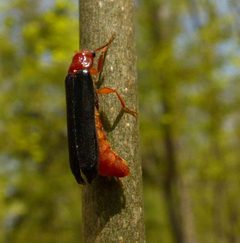
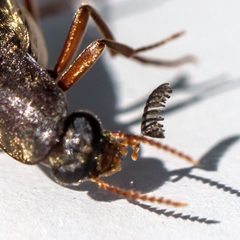
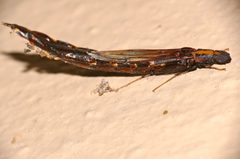
Pronunciation
How to pronounce Lymexylidae: //lɪˈmɛksɪlaɪdiː//
These audio files are automatically generated. While they are not always 100% accurate, they are a good starting point.
Identification
can be distinguished from other wood-boring beetles by the combination of: short exposing multiple articulated abdominal tergites; 11-segmented, often sexually dimorphic ; and the distinctive male palp organ on the maxillary palpi. The highly reduced elytra of Atractocerinae, exposing most of the and leaving hind wings uncovered, creates an -like or -like appearance unlike typical beetles. The is distinguished from Cerambycidae by the short antennae (not exceeding body length) and exposed abdominal tergites. From Staphylinidae, they differ in having elytra that are not completely abbreviated and in the structure of the hind wing venation.
Images
Habitat
Larvae inhabit tunnels bored into living and decaying wood of hardwood trees including chestnut, poplar, and oak. Some occur in palm stems. are attracted to light at night. The symbiotic fungi require airflow, so larvae maintain clean tunnels free of debris.
Distribution
Worldwide distribution. Documented from North America (eastern US, Canada, Vermont), Europe (Czech Republic, Denmark, Norway, Sweden, Greece), Africa (South Africa, Limpopo Province), Asia (Myanmar, Ukraine), Central and South America ( Rica, Guatemala, Mexico, Ecuador, Brazil), and Seychelles. Fossil records from Burmese amber (Myanmar, Late Cretaceous), Baltic amber (Eocene), Rovno amber (Ukraine, Eocene), and Crato Formation (Brazil, Early Cretaceous) indicate ancient lineage presence in Eocene European amber forests and Cretaceous paleotropics.
Diet
Larvae feed on ambrosia fungi (specifically Alloascoidea hylecoeti and the yeast-like fungus Endomyces hylecoeti) that they cultivate on tunnel walls, rather than consuming wood directly. of some may be predatory, suggested by large size in Atractocerus.
Host Associations
- Cocos nucifera - larval Melittomma insulare larvae bore into bases of coconut palms, causing palm death in Seychelles
- Castanea - larval chestnut trees
- Populus - larval poplar trees
- Quercus - larval oak trees
- Betula pubescens - attraction attraction documented
- Alnus incana - attraction attraction documented
- Pinus sylvestris - attraction attraction documented
Life Cycle
Females deposit coated with fungal spores from a pouch near the ovipositor. Larvae hatch and remain near egg shells to collect spores before tunneling deeper into wood. Larvae bore into wood, creating tunnels where they cultivate fungi on the walls. The larval stage is the primary wood-boring and feeding stage. occurs within the wood tunnels. emerge from the wood. Specific developmental timing and number of instars are not well documented for most .
Behavior
Larvae engage in active fungus farming: they maintain tunnels to ensure airflow for fungal growth, clean debris from galleries, and consume the cultivated fungi. Larvae carry fungal spores on their bodies when dispersing to new tunnels. of Atractocerus are and attracted to ultraviolet light. Some are capable of tree selection prior to landing using olfactory and visual cues.
Ecological Role
Larvae function as engineers by creating wood tunnels that alter wood structure and facilitate fungal . The symbiotic relationship with ambrosia fungi represents a specialized form of external rumination. Some contribute to forest by causing decay in living trees. As pests, they can significantly impact timber quality and tree survival in both natural forests and plantations.
Human Relevance
Several are economically significant pests. Lymexylon navale, the ship timber , has historically been a destructive pest of ship timbers, giving the its . Melittomma sericeum, the chestnut timberworm, and Elateroides lugubris, the sapwood timberworm, occur in eastern North America. Melittomma insulare is a serious pest of coconut palms in Seychelles, causing extensive palm mortality; control methods using coal tar creosote have been developed. The family has been studied as a potential model for understanding the evolution of fungus-farming in insects.
Similar Taxa
- StaphylinidaeRove beetles also have short , but differ in having elytra that do not completely expose the and in their distinctive wing venation with a short or absent radial
- CerambycidaeLonghorn beetles are wood-borers but have very long (often exceeding body length) and complete covering the , unlike the short elytra and short antennae of
- StrepsipteraStylopids (twisted-winged ) were once thought related due to reduced forewings, but this is now considered convergent; are true beetles with complete and different wing structure
- LampyridaeSome classifications placed near fireflies based on wing venation, but current evidence places Lymexylidae in Cucujiformia, not Elateriformia
More Details
Evolutionary significance
are considered 'living fossils' with the oldest known fossil being a primitive Atractocerus from 100 million year old Burmese amber, indicating the lineage appeared by the mid-Cretaceous and possibly originated in the Jurassic. They were once thought to be among the most primitive beetles due to simple wing venation, undifferentiated and , and naked , but are now placed in the derived Cucujiformia series. Phylogenetic placement remains debated: morphological data place them within Tenebrionoidea, while molecular data place them as sister to Tenebrionoidea.
Symbiotic system details
The fungus- is one of the few known cases of obligate mutualism involving ambrosia fungi in Coleoptera. The system is analogous to the better-known ambrosia beetle-fungus mutualisms in Scolytinae, but evolved independently. The fungal partner benefits from and , while the beetle receives a specialized food source that allows exploitation of wood without cellulose-digesting .
Taxonomic instability
The superfamily Lymexyloidea contains only , making it a superfamily. Internal remains unresolved, with disagreement between morphological and molecular datasets. The contains four : Atractocerinae, Hylecoetinae, Lymexylinae, and Melittommatinae.
Sources and further reading
- BugGuide
- Wikipedia
- GBIF taxonomy match
- iNaturalist taxon
- NCBI Taxonomy
- Catalogue of Life
- Lymexylidae | Beetles In The Bush
- Fossil Record celebrates its Open Access anniversary with Pensoft | Blog
- 10 years of Open Access: Museum für Naturkunde and Pensoft
- Distribution and New Records of Lymexylidae (Coleoptera: Lymexyloidea) in Guatemala and Mexico
- The control of the coconut pest Melittomma insulare (Coleoptera, Lymexylidae) in Seychelles.
- First fossil species of ship-timber beetles (Coleoptera, Lymexylidae) from Eocene Rovno amber (Ukraine)
- The distribution of the Ship-timber beetle Elateroides flabellicornis (Schneider, 1791) (Coleoptera: Lymexylidae) in the Czech Republic
- First Record of Lymexylidae (Coleoptera: Lymexyloidea) from Ecuador, with Notes on Their Distribution
- Primary attraction and host tree selection in deciduous and conifer living Coleoptera: Scolytidae, Curculionidae, Cerambycidae and Lymexylidae