
Clivina fossor
(Linnaeus, 1758)
Digger Slope-rumped Beetle
Species Guides
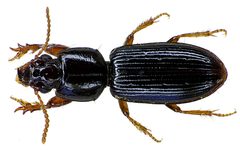
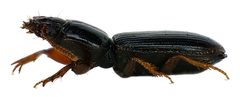
1Clivina fossor is a ground beetle in the Scaritinae, described by Linnaeus in 1758. It is the largest in its subfamily, characterized by (digging) adaptations including broad tarsal segments on the forelegs. The species exhibits a widespread Palaearctic distribution with introduced in North America, and shows flexible use across grasslands, wetlands, woodlands, and agricultural areas. are and subterranean by day, while larvae live entirely underground.
Pronunciation
How to pronounce Clivina fossor: /ˈklɪvɪnə ˈfɒsɔːr/
These audio files are automatically generated. While they are not always 100% accurate, they are a good starting point.
Identification
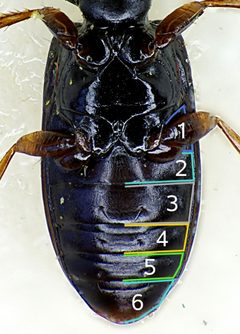
Distinguished from other Clivina by large body size (largest in ). Broad foreleg tarsal segments indicate habit. Continuous setiferous punctures on separate it from similar ground beetles. in terminal sternite setae pattern useful for distinguishing sexes.
Images
Habitat
Damp areas of grassland, wetland, arable land, woodland, and peat bogs. remain subterranean during daylight hours. Larvae are entirely endogeic (living within soil).
Distribution
Native: Widespread across Palaearctic region including Great Britain, Ireland, most small islands, and Shetland. Introduced: North America (Canada, USA). Specific collection records from Wytham Woods, Oxfordshire and Bookham Common, Leatherhead, UK.
Seasonality
active year-round. New appear in late summer.
Life Cycle
active year-round with new appearing in late summer. Larvae develop entirely underground (endogeic).
Behavior
surface activity with subterranean . dig using broad foreleg tarsal segments. Rapid local range expansion facilitated by -capable adults. Eurytopic preference allows of diverse moist environments.
Similar Taxa
- Other Clivina speciesSmaller body size; C. fossor is distinctly the largest in Scaritinae
- Other Scaritinae generaLack combination of continuous elytral punctures, elongate with large lateral , and broad foreleg
More Details
Genome
assembly of 612.60 Mb spanning 22 chromosomal pseudomolecules (21 + X ). Source: Wellcome Open Research genome sequencing project.
Sources and further reading
- BugGuide
- Wikipedia
- GBIF taxonomy match
- iNaturalist taxon
- NCBI Taxonomy
- Catalogue of Life
- Bug Eric: Fossorial Mason Wasps, genus Pterocheilus
- Where siblings mingle: Ellipsoptera marginata vs. E. hamata | Beetles In The Bush
- Bug Eric: Wasp Wednesday: Anacrabro ocellatus
- Bug Eric: March Flies in May
- Shining like a diamond: a new species of diamond frog from northern Madagascar | Blog
- Bug Eric: Wasp Wednesday: Great Golden Digger
- The genome sequence of a ground beetle, Clivina fossor (Linnaeus, 1758).