
Clivina
Latreille, 1802
Species Guides
19- Clivina acuducta
- Clivina alabama
- Clivina americana
- Clivina californica
- Clivina collaris
- Clivina dentipes
- Clivina fossor(Digger Slope-rumped Beetle)
- Clivina impressefrons(Slender Seedcorn Beetle)
- Clivina morio
Clivina is a of ground beetles in the Carabidae, Scaritinae, comprising over 600 described . The genus has a broad geographic distribution spanning the Palearctic, Nearctic, Near East, and North Africa. Species in this genus are generally , with morphological adaptations for burrowing in soil. Well-studied species include Clivina fossor, whose has been sequenced, and Clivina impressifrons, an agricultural species with documented feeding habits.
Pronunciation
How to pronounce Clivina: //klaɪˈviːnə//
These audio files are automatically generated. While they are not always 100% accurate, they are a good starting point.
Identification
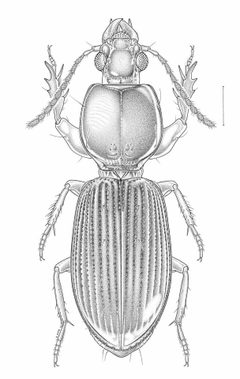
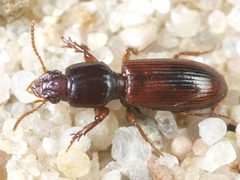
Clivina are characterized by adaptations including broad tarsal segments on the forelegs. Clivina fossor, the largest species in the , can be distinguished by a continuous series of setiferous punctures between the elytral humerus and apex, an elongate with large lateral , and short . Sexes in C. fossor are distinguished by fine setae along the margin of the terminal sternite in females. Species-level identification within the is difficult and often requires examination of male genitalia.
Images
Habitat
occupy diverse soil including damp grasslands, wetlands, arable land, woodlands, and peat bogs. remain subterranean during daylight hours. Agricultural species such as Clivina impressifrons are associated with corn fields and cultivated soils.
Distribution
Native range includes the Palearctic, Nearctic, Near East, and North Africa. Clivina fossor is widespread across the Palaearctic region and has been introduced to North America, with established across Great Britain and Ireland including most small islands and Shetland.
Seasonality
of Clivina fossor are active year-round, with new appearing in late summer.
Diet
Clivina impressifrons is primarily but has been observed feeding on germinating corn seed when primary prey is absent or scarce. The slender seedcorn beetle may serve as a of soil pests in agricultural systems.
Life Cycle
Larvae are entirely endogeic (soil-dwelling). In Clivina fossor, new appear in late summer.
Behavior
are , remaining underground during the day and becoming active at night. Clivina fossor possesses wings enabling rapid local range expansion. Activity in Clivina impressifrons is temperature-dependent, with biological activities slowing below 16°C and ceasing below 10°C.
Ecological Role
of soil-dwelling organisms. Clivina impressifrons may provide beneficial pest control in agricultural systems by preying on soil pests of corn, though occasional seed damage occurs. Clivina ypsilon serves as for mites of the Caraboacaridae, contributing to the known host range of this mite family.
Human Relevance
Clivina impressifrons is known as the slender seedcorn beetle and can damage germinating corn seed, though its overall impact may be mitigated by on soil pests. The includes introduced such as Clivina fossor in North America.
Similar Taxa
- Other Scaritinae generaClivina belongs to a group of superficially similar ground beetles that require careful examination for proper identification; the comment in source material notes that Clivina and related all superficially look the same.
More Details
Genomic resources
The of Clivina fossor has been sequenced as part of the Darwin Tree of Life Project, with an assembly spanning 612.60 megabases and 86.33% scaffolded into 22 chromosomal pseudomolecules.
Mite associations
Clivina ypsilon has been documented as for Intercaraboacarus clivinus, a new and of mite in the Caraboacaridae described from Iran, representing the first record of this mite family associated with Clivina beetles.
Sources and further reading
- BugGuide
- Wikipedia
- GBIF taxonomy match
- iNaturalist taxon
- NCBI Taxonomy
- Catalogue of Life
- Where siblings mingle: Ellipsoptera marginata vs. E. hamata | Beetles In The Bush
- Observations on the Biology of the Slender Seedcorn Beetle, Clivina Impressifrons (Coleoptera: Carabidae)
- A new genus and species of mites of the family Caraboacaridae (Acari: Heterostigmata) associated withClivina ypsilon(Coleoptera: Carabidae) with notes on distribution and host range of the family
- The genome sequence of a ground beetle, Clivina fossor (Linnaeus, 1758).