
Notiophilus semistriatus
Say, 1823
semi-striate big-eyed beetle
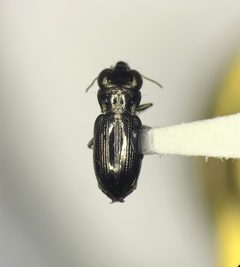
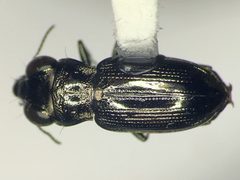
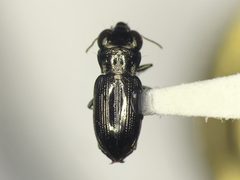
Notiophilus semistriatus is a ground beetle in the Carabidae, commonly known as the semi- big-eyed . It exhibits wing dimorphism, with containing both fully-winged () and short-winged (brachypterous) . The is primarily active during daylight hours. It occupies a range of open and edge across northern North America and extends into Russia.
Pronunciation
How to pronounce Notiophilus semistriatus: //nəʊ.tiˈɒf.ɪ.ləs ˌsɛm.iˈstrɑɪ.ə.təs//
These audio files are automatically generated. While they are not always 100% accurate, they are a good starting point.
Identification
Wing dimorphism is a key diagnostic feature: some individuals possess fully developed wings, while others have reduced, non-functional wings. The specific epithet 'semistriatus' refers to partially (grooved) , distinguishing it from fully striate . As a member of Notiophilus, it shares the 's characteristic large, prominent adapted for visual hunting. Differentiation from other Notiophilus requires examination of elytral striation patterns and subtle body proportions.
Images
Habitat
Inhabits moraines, abandoned fields, roadsides, orchards, and forest edges. These environments share characteristics of open ground with sparse vegetation and exposed soil surfaces.
Distribution
Recorded from Alaska, Canada, the contiguous United States, and Russia. Present throughout northern North America with trans-Beringian distribution extending into eastern Russia.
Behavior
are mostly . The exhibits wing dimorphism, with some adults and others brachypterous.
Similar Taxa
- Notiophilus biguttatusEuropean with similar preferences; distinguished by elytral punctation and striation patterns
- Notiophilus rufipesNorth American ; separation requires detailed examination of elytral and body proportions
More Details
Taxonomic note
Authority sometimes cited as LeConte, 1857 in secondary sources, but original description by Say, 1823 takes precedence.
Wing dimorphism significance
The presence of both and brachypterous forms within suggests adaptive flexibility in capability, potentially correlating with stability or dynamics.