
Poecilus lucublandus
(Say, 1823)
Woodland Ground Beetle
Species Guides
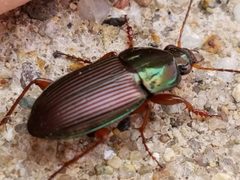
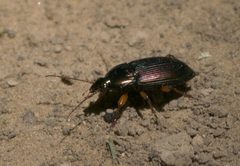
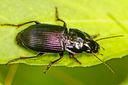
1Poecilus lucublandus is a of woodland ground beetle in the Carabidae, native to North America. It is one of several Poecilus species found in woodland and forested . The species has been documented in studies examining the effects of agricultural practices on beneficial ground beetle , where it serves as a useful indicator of environmental disturbance. Two are recognized: P. l. lucublandus and P. l. manhattanis.
Pronunciation
How to pronounce Poecilus lucublandus: /pɔɪˈsaɪləs ˌluːkuˈblændəs/
These audio files are automatically generated. While they are not always 100% accurate, they are a good starting point.
Identification
Members of the Poecilus are medium-sized ground beetles with elongated bodies and relatively long legs. P. lucublandus can be distinguished from similar Poecilus by subtle differences in elytral and coloration, though precise diagnostic features require examination of genitalia or reference to regional keys. It is generally larger than Bembidion species and lacks the metallic coloration seen in some Carabus or Cicindela.
Images
Habitat
Woodland and forested environments, including deciduous and mixed forests. The has been observed in agricultural landscapes adjacent to woodland , suggesting some of edge habitats and moderate disturbance.
Distribution
North America, with confirmed records from the United States and Canada. Distribution appears centered in eastern and central North America, though precise range boundaries are not well documented.
Ecological Role
As a ground-dwelling carabid , P. lucublandus likely functions as a of small in forest floor . Like other Poecilus , it may contribute to regulation of pest in agricultural areas near woodland . The species has been used as a bioindicator in studies of farming practice impacts on beneficial insect diversity.
Human Relevance
P. lucublandus has been included in agricultural research as an for assessing the effects of soil management practices on beneficial ground beetle . Studies indicate that strip tillage practices, which reduce soil disturbance, help maintain of this and other carabid compared to conventional intensive tillage or plasticulture systems.
Similar Taxa
- Poecilus chalcitesAnother Poecilus frequently captured in agricultural field studies; P. lucublandus tends to be associated with more wooded while P. chalcites appears more common in open agricultural fields.
- Harpalus pensylvanicusOften co-occurs in agricultural studies and similar size range, but Harpalus have different body proportions and elytral microsculpture; P. lucublandus has more pronounced woodland association.
- Poecilus lucublandus manhattanisRecognized ; separation requires detailed examination of morphological characters with reference to original description by Casey.
More Details
Subspecies
Two are recognized: Poecilus lucublandus lucublandus (Say, 1823) and Poecilus lucublandus manhattanis Casey. The latter was described from the Manhattan area and may represent a geographically restricted form, though modern taxonomic evaluation of subspecific validity has not been documented in available sources.
Research significance
P. lucublandus was among the captured in a two-year study (2013-2014) examining ground beetle responses to farming practices in squash and gourd production, though it was not among the captured. The study highlighted that even relatively uncommon carabid species show sensitivity to soil management techniques.