
Calathus ruficollis ignicollis
Casey, 1920
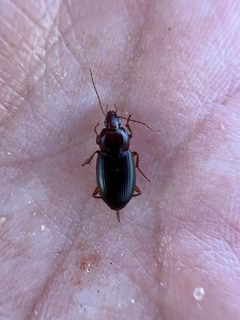
Calathus ruficollis ignicollis is a flightless ground beetle to the Transverse Ranges of southern California. First described by Casey in 1920, it represents the southern Sierra Nevada of the broader C. ruficollis complex. Phylogeographic studies indicate this subspecies is genetically distinct from populations south and west, corresponding to a deep mitochondrial split within the . Despite being flightless, the species shows limited geographic structure, suggesting recent range expansion or across mountain barriers.
Pronunciation
How to pronounce Calathus ruficollis ignicollis: /kəˈlæθəs ruːfɪˈkɒlɪs ˌɪɡnɪˈkɒlɪs/
These audio files are automatically generated. While they are not always 100% accurate, they are a good starting point.
Identification
Distinguished from the nominate C. r. ruficollis by geographic distribution in the Transverse Ranges/southern Sierra Nevada. As a flightless ground beetle, lack functional wings. Specific morphological differences from other subspecies are not documented in available sources.
Images
Habitat
Transverse Ranges of southern California; associated with montane in the southern Sierra Nevada region.
Distribution
to the Transverse Ranges of southern California, specifically the southern Sierra Nevada . Part of the broader Calathus ruficollis distribution across southern California.
Behavior
Flightless; are ground-dwelling.
Similar Taxa
- Calathus ruficollis ruficollisNominate occurring south and west of the Transverse Ranges; separated by deep mitochondrial divergence and geographic barrier.
More Details
Phylogeographic significance
The split between C. r. ignicollis and C. r. ruficollis represents the deepest genetic divergence within the , corresponding to the geographic boundary of the Transverse Ranges.
Colonization patterns
Despite being flightless, C. ruficollis shows limited genetic structure across its range, with mismatch distributions and Fu's Fs statistics indicating range expansion in several . The Santa Cruz Island population shares haplotypes with mainland populations, suggesting multiple events rather than long-term isolation.
Sources and further reading
- BugGuide
- GBIF taxonomy match
- iNaturalist taxon
- Catalogue of Life
- Clouded beetles amidst spectacular scenery | Beetles In The Bush
- The ever-increasing diversity of Oklahoma beetles | Beetles In The Bush
- Oedemeridae | Beetles In The Bush
- Bee Assassin on Coneflower | Beetles In The Bush
- A flower visiting jewel beetle that is not an Acmaeodera | Beetles In The Bush
- Oklahoma is for lovers | Beetles In The Bush
- Limited phylogeographic structure in the flightless ground beetle, Calathus ruficollis, in southern California