
Calathus
Bonelli, 1810
Species Guides
8Calathus is a of ground beetles (Carabidae) in the Platyninae, comprising at least 190 described . The genus is native to the Palearctic region, extending into the Near East and North Africa, with notable diversity centers in the Mediterranean Basin and Ethiopian Highlands. Species occupy diverse ranging from coastal dunes to montane forests above 3,600 meters elevation. The subgenus Calathus shows a constant rate of diversification from the late Miocene onward, with westward events from the eastern Mediterranean shaping current distributions.
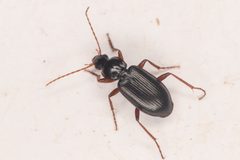
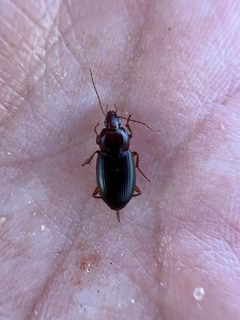
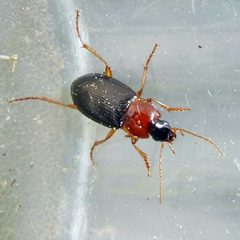
Pronunciation
How to pronounce Calathus: //ˈkæ.lə.θəs//
These audio files are automatically generated. While they are not always 100% accurate, they are a good starting point.
Images
Habitat
varies substantially among . Coastal species such as Calathus mollis inhabit dunes and dune-like habitats, including near-coastal sand pioneer vegetation on dredged material deposition sites. Montane species occur in Ethiopian Highlands at 3,600–4,150 meters elevation, found under stones at the base of giant lobelias (Lobelia rhynchopetalum) or on barren high-elevation soils. Other species occupy forest and open ground habitats across temperate and Mediterranean zones.
Distribution
Native to the Palearctic region (including Europe), the Near East, and North Africa. The subgenus Calathus diversified primarily from the Anatolian Peninsula as a center of origin, with successive westward events into the western Mediterranean Basin. Atlantic-Mediterranean distribution patterns occur in some . North American records (Vermont, US) represent introduced or vagrant occurrences. The includes Eocene fossil species from Baltic amber deposits.
Seasonality
Activity patterns vary by and latitude. Calathus mollis shows main activity in late summer through autumn, with detectable winter activity at its northeastern range margin. Calathus granatensis exhibits autumn breeding with bimodal activity peaks corresponding to new appearance and reproductive activity. Calathus melanocephalus in northern taiga shows seasonal patterns adapted to high-latitude conditions.
Life Cycle
strategies vary among . Calathus granatensis is an autumn breeder with a long period from late summer through the following winter, optimal reproduction occurring mainly in October; it shows no thermic or larval hibernation. Calathus melanocephalus exhibits food-dependent reproduction: production correlates with food gathered, and sufficient autumn feeding is required to build fat reserves for winter survival. Larval development duration varies with temperature and food availability, affecting body size.
Behavior
are ground-dwelling and flightless in some (e.g., Calathus ruficollis). Calathus melanocephalus shows feeding activity concentrated in the first part of autumn, with insufficient food availability in late autumn limiting winter survival. Some exhibit range expansion dynamics, as documented for Calathus mollis spreading along the Baltic Sea coast since approximately 2011.
Ecological Role
As ground beetles, likely function as and scavengers in soil and litter . Specific roles have not been quantified for most species.
Human Relevance
Calathus mollis has undergone recent range expansion in northern Germany, prompting reevaluation of its conservation status from critically endangered to not threatened; monitoring of this expansion is considered valuable for documenting climate-driven faunal change. Some occur in anthropogenic such as dredged material deposition sites.
Similar Taxa
- PterostichusBoth are ground beetle in Carabidae with similar body plans; distinguished by taxonomic placement in different subtribes (Calathina vs. Pterostichina) and subtle morphological differences in elytral structure and male genitalia.
More Details
Phylogeographic structure
Calathus ruficollis in southern California shows limited phylogeographic structure despite being flightless, with deep divergence only between southern Sierra Nevada and other ; Santa Cruz Island populations show multiple events from mainland sources.
Fossil record
Calathus elpis is known from Eocene Baltic amber, indicating the was present in Paleogene forests of northern Europe.
Diversification history
Molecular analyses indicate constant speciation rates from the late Miocene for the subgenus Calathus, with Pleistocene climatic oscillations influencing intraspecific diversity patterns rather than driving increased speciation; this pattern fits the pulse model of diversification.
Sources and further reading
- BugGuide
- Wikipedia
- GBIF taxonomy match
- iNaturalist taxon
- NCBI Taxonomy
- Catalogue of Life
- Calathus-carballalae - Entomology Today
- Two New Species of Carabid Beetles Found in Ethiopia
- Research News Archives - Page 136 of 155 - Entomology Today
- On the life history of Calathus granatensis (Coleoptera Carabidae) in southwest Iberian Peninsula
- Fossil carabids from Baltic amber – I –A new species of the genus Calathus Bonelli, 1810(Coleoptera: Carabidae: Pterostichinae)
- \emph{Calathus mollis} – Einwanderung und Phänologie einer atlanto-mediterranen Laufkäferart in Mecklenburg-Vorpommern (Coleoptera: Carabidae)
- Seasonal aspects of life cycles in Calathus melanocephalus and C. micropterus (Coleoptera, Carabidae) in the northern taiga
- On the relationship between food, reproduction and survival of two carabid beetles: Calathus melanocephalus and Pterostichus versicolor
- Diversification of subgenus Calathus (Coleoptera: Carabidae) in the Mediterranean region – glacial refugia and taxon pulses
- Limited phylogeographic structure in the flightless ground beetle, Calathus ruficollis, in southern California