
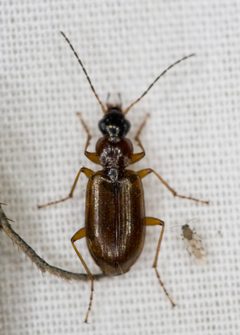
Agonum ferruginosum
(Dejean, 1828)
Agonum ferruginosum is a ground beetle in the Platyninae, described by Dejean in 1828. It occurs in North America with records from the United States, Canada, and Alaska. In central Alberta marshes, it is one of the most abundant carabid in emergent vegetation of flooded zones, where it exhibits partitioning with sympatric . The species is and shows earlier and compared to some co-occurring Agonum species.
Pronunciation
How to pronounce Agonum ferruginosum: /əˈɡoʊnəm ˌfɛr.ˌʊdʒ.əˈnoʊ.səm/
These audio files are automatically generated. While they are not always 100% accurate, they are a good starting point.
Identification
In central Alberta marshes, A. ferruginosum can be distinguished from sympatric A. nigriceps by preference: A. ferruginosum occurs in floating cattail mats or flooded Carex, while A. nigriceps is associated with emergent sedge tussocks. Where it co-occurs with A. lutulentum, their macrohabitat distributions are mutually exclusive. of A. ferruginosum lack the strong climbing propensity on narrow vertical structures shown by A. nigriceps.
Images
Habitat
Marshes in central Alberta, Canada; emergent vegetation of flooded zones; floating cattail (Typha) mats in some marshes, flooded Carex in others; microsites with emergent substrate or piles of dead vegetation within flooded macrohabitats. Also recorded from turfgrass in the United States.
Distribution
North America: United States ( per some sources), Canada (central Alberta, with confirmed marsh studies), Alaska. GBIF records indicate presence across USA, Canada, and Alaska.
Seasonality
In central Alberta, and occur earlier than in sympatric A. thoreyi. activity pattern.
Life Cycle
begins earlier than in A. thoreyi; emerge earlier than in A. thoreyi.
Behavior
; daily activity cycles similar to other sympatric Agonum . In laboratory conditions, show lower propensity to climb narrow vertical structures compared to A. nigriceps. Exhibits partitioning: where co-occurring with A. lutulentum, macrohabitat occupations are mutually exclusive.
Ecological Role
Human Relevance
Potential agent in turfgrass systems; included in University of Georgia studies using clay caterpillar models to assess predatory activity in managed grasslands.
Similar Taxa
- Agonum nigricepsSympatric in central Alberta marshes; distinguished by association with emergent sedge tussocks, stronger climbing on vertical structures, and cryptic coloration matching sedge .
- Agonum thoreyiSympatric in central Alberta marshes; distinguished by later and , and more even distribution across macrohabitats rather than concentration in cattail mats or flooded Carex.
- Agonum lutulentumWhere co-occurring in marshes, shows mutually exclusive macrohabitat distribution with A. ferruginosum.
More Details
Taxonomic Note
Originally described as Anchomenus ferruginosus by Dejean in 1828; later transferred to Agonum. Some sources describe the as to the United States, though verified records and ecological studies confirm presence in Canada (central Alberta, Alaska).
Research Context
The was included in a 1986 study on resource partitioning among marsh-dwelling Agonum in central Alberta, providing detailed information on use and temporal activity patterns relative to .
Sources and further reading
- BugGuide
- Wikipedia
- GBIF taxonomy match
- iNaturalist taxon
- NCBI Taxonomy
- Don't get bogged down with peat... - Buglife Blog - Buglife
- Clues in the Clay: Decoy Insect Larvae Reveal Predator Presence in Turfgrass
- beetle and caterpillar clay models - Entomology Today
- RESOURCE PARTITIONING IN A GUILD OF MARSH-DWELLING AGONUM (COLEOPTERA: CARABIDAE) IN CENTRAL ALBERTA