
Agonum lutulentum
(LeConte, 1854)
Brown-prothorax Ground Beetle
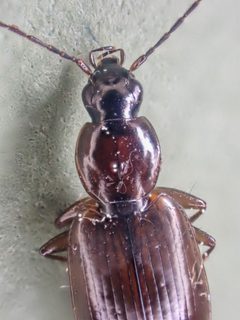
Agonum lutulentum is a ground beetle in the Carabidae, commonly known as the Brown-prothorax Ground Beetle. It inhabits marsh environments, particularly the emergent vegetation of flooded zones. The exhibits resource partitioning , occupying macrohabitats that are mutually exclusive with sympatric such as A. ferruginosum. It is native to North America, with documented occurrence in central Alberta, Canada.
Pronunciation
How to pronounce Agonum lutulentum: /əˈɡoʊnəm luːˈtjuːlɛntəm/
These audio files are automatically generated. While they are not always 100% accurate, they are a good starting point.
Identification
Identification of A. lutulentum requires examination of morphological features distinguishing it from other Agonum . In central Alberta, it can be differentiated from sympatric marsh-dwelling (A. nigriceps, A. ferruginosum, A. thoreyi) by its specific macrohabitat occupation pattern, where it shows mutually exclusive distribution with A. ferruginosum when co-occurring in the same marsh.
Images
Habitat
Emergent vegetation of flooded zones in marshes. Macrohabitat occupation is mutually exclusive with A. ferruginosum where the two occur sympatrically, indicating specialized use within marsh systems.
Distribution
North America. Documented in central Alberta, Canada. GBIF records indicate presence in Canada and USA.
Behavior
Exhibits resource partitioning through mutually exclusive macrohabitat occupation with A. ferruginosum, suggesting specialization that reduces .
Similar Taxa
- Agonum ferruginosumCo-occurs in marshes but occupies mutually exclusive macrohabitats, allowing coexistence through resource partitioning
- Agonum nigricepsSympatric marsh-dwelling segregated by use, primarily occupying emergent sedge tussocks
- Agonum thoreyiSympatric with more even distribution across macrohabitats and later reproductive timing
More Details
Sources and further reading
- BugGuide
- Wikipedia
- GBIF taxonomy match
- iNaturalist taxon
- NCBI Taxonomy
- Don't get bogged down with peat... - Buglife Blog - Buglife
- Clues in the Clay: Decoy Insect Larvae Reveal Predator Presence in Turfgrass
- beetle and caterpillar clay models - Entomology Today
- RESOURCE PARTITIONING IN A GUILD OF MARSH-DWELLING AGONUM (COLEOPTERA: CARABIDAE) IN CENTRAL ALBERTA