
Agonum
Bonelli, 1810
Species Guides
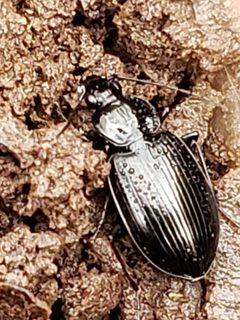
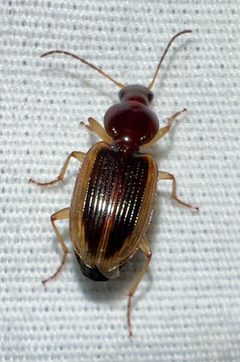
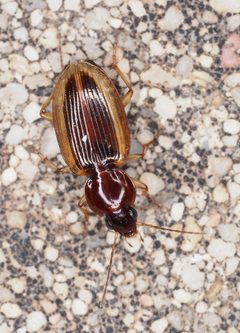
58Agonum is a large of ground beetles in the Platyninae, tribe Platynini. are mid-sized to smallish beetles, typically exhibiting dark metallic coloration in reddish, bronze, black, or green hues. The genus is primarily distributed across the Holarctic and Mediterranean regions, with some extension into East Africa. Members are strongly associated with wet throughout their , including marshes, peat bogs, wet meadows, and riverbanks. Several species have been documented as of aphids and other small in agricultural and natural .
Pronunciation
How to pronounce Agonum: //əˈɡoʊnəm//
These audio files are automatically generated. While they are not always 100% accurate, they are a good starting point.
Identification
Distinguished from other Platynini by combination of body shape, coloration, and male genitalia . -level identification requires examination of pronotum shape, elytral color patterns, and structure. Similar to related in Platynini but generally separable by geographic distribution and subtle morphological characters. Some (e.g., Agonum sexpunctatum group) require careful dissection for reliable determination.
Images
Habitat
Strongly hygrophilous throughout . Occupies marshes, peat bogs, wet meadows, riverbanks, flooded zones with emergent vegetation, and sedge tussocks. Some occur in floating vegetation mats, aspen woodlands, and agricultural fields with sufficient ground moisture. specificity varies among species, with some showing narrow microhabitat preferences (e.g., sedge tussocks vs. floating cattail mats).
Distribution
Primarily Holarctic and Mediterranean region; extends into Central Asia, the Himalaya region (southern limit poorly understood), and East Africa. Particularly well-represented in Ireland, where abundance exceeds that of elsewhere in Europe. Individual show varying ranges, with some restricted to specific mountain systems or regional endemics.
Seasonality
Activity patterns vary by . timing differs among sympatric species, with some beginning earlier and producing sooner. Generally in activity. Seasonal presence influenced by hydrology and regional climate.
Diet
Predatory on small . Documented prey includes aphids (captured on vegetation and ground), other soft-bodied arthropods. Agonum dorsale feeds on cereal aphids; A. muelleri preys on . Ground-foraging capture prey available in the ground zone.
Life Cycle
Holometabolous with , larval, pupal, and stages. timing varies among , with some producing adults earlier in season than sympatric . Wing present in some species (e.g., A. retractum), with both short-winged (brachypterous) and long-winged () females; males mainly short-winged. Long-winged females may lose ability after reproduction due to flight muscle .
Behavior
Primarily . Ground-foraging spend most time searching for prey on substrate surface, climbing vegetation infrequently or readily depending on species. Agonum nigriceps shows high propensity to climb narrow vertical structures, correlated with sedge tussock . Agonum muelleri readily climbs soybean plants. Some species exhibit microhabitat segregation where sympatric, partitioning resources by spatial distribution and structural habitat use.
Ecological Role
in wetland and agricultural . Contributes to of pest aphids in cereal and soybean crops. Participates in chemical cycling in woodland ecosystems. Member of predator guilds in marsh systems where resource partitioning among may reduce competition.
Human Relevance
Beneficial as agent of agricultural pests, particularly aphids in cereal and legume crops. Potential for conservation in peatland restoration projects. Subject of ecological research on -prey dynamics, fragmentation effects, and wetland biodiversity. Some used as indicators of habitat quality in marsh and bog .
Similar Taxa
- Other Platynini genera (e.g., Platynus)Similar elongate body form and metallic coloration; distinguished by subtle morphological characters including pronotum and genitalia structure
- CalosomaBoth ground beetles but Calosoma larger, more robust, with different body proportions and typically more active climber of vegetation
More Details
Wing polymorphism
Some exhibit wing dimorphism with ecological and implications. In A. retractum, long-winged females may function as colonizers but lose capability after .
Resource partitioning
Sympatric marsh-dwelling show segregation through differential use of microhabitats (sedge tussocks, floating mats, emergent substrate), potentially facilitating coexistence.
Conservation concern
Peatland A. ericeti has been studied in relation to fragmentation, indicating vulnerability of wetland-dependent to habitat loss.
Sources and further reading
- BugGuide
- Wikipedia
- iNaturalist taxon
- NCBI Taxonomy
- Catalogue of Life
- Don't get bogged down with peat... - Buglife Blog - Buglife
- Clues in the Clay: Decoy Insect Larvae Reveal Predator Presence in Turfgrass
- beetle and caterpillar clay models - Entomology Today
- Agonum fuliginosum (Panzer, 1809). A New Record from the Faroe Islands / Agonum fuliginosum (Panzer, 1809). Nýggj skráseting úr Føroyum
- Foraging by the carabid Agonum dorsale in the field
- Agonum retractum (Coleoptera: Carabidae) in an Aspen woodland in the Canadian Rockies: population biology and chemical cycling
- Spring dispersal and summer habitat distribution of Agonum dorsale (Coleoptera, Carabidae)
- RESOURCE PARTITIONING IN A GUILD OF MARSH-DWELLING AGONUM (COLEOPTERA: CARABIDAE) IN CENTRAL ALBERTA
- Climbing behaviour and aphid predation byAgonum muelleri(Coleoptera: Carabidae)
- Wing polymorphism in the insect species Agonum retractum Leconte (Coleoptera: Carabidae)
- A contribution to Bulgarian ground beetle fauna (Coleoptera: Carabidae) with the first record of Agonum carbonarium Dejean, 1828 for the country
- Agonum tulliae sp. n. from the Sila National Park (Calabria, southern Italy) (Coleoptera: Carabidae: Platynini)
- Survival of Populations of Agonum Ericeti Panz. (Col., Carabidae) in Relation To Fragmentation of Habitats