
Agonum aeruginosum
Dejean, 1828
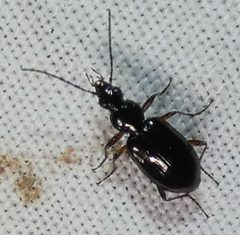
Agonum aeruginosum is a of ground beetle in the Carabidae. It occurs in North America, with records from Canada and the United States. As a member of the Agonum, it belongs to a group of small to medium-sized carabid beetles commonly found in moist . The species name "aeruginosum" refers to a -green or verdigris coloration, though specific color details for this species are not well documented in available sources.
Pronunciation
How to pronounce Agonum aeruginosum: //əˈɡoʊ.nəm ɛˌruː.dʒɪˈnoʊ.səm//
These audio files are automatically generated. While they are not always 100% accurate, they are a good starting point.
Identification
Agonum aeruginosum can be distinguished from other Agonum by subtle morphological features of the and pronotum, though specific diagnostic characters are not detailed in available literature. The Agonum is characterized by elongated body form, thread-like , and typically metallic coloration. Species-level identification within Agonum generally requires examination of male genitalia and fine details of elytral striation and punctuation.
Images
Distribution
North America: Canada and the United States. GBIF records confirm presence in both countries.
Ecological Role
As a ground beetle (Carabidae), Agonum aeruginosum likely functions as a of small in its . Members of the Agonum have been documented as predators in turfgrass , where they contribute to of pest insects.
Human Relevance
Indirect relevance through potential contribution to biological pest control in managed landscapes. Agonum have been identified as part of the in turfgrass systems studied for applications.
Similar Taxa
- Other Agonum speciesCongeneric share similar body form, size range, and general preferences, requiring careful examination for accurate identification.
- Other Platyninae ground beetlesMembers of the Platyninae share elongated body shape and similar ecological habits, potentially overlapping in distribution and .
More Details
Taxonomic Note
There is a discrepancy in authorship dates in sources: Dejean (1828) is cited by GBIF and NCBI as the accepted authority, while Catalogue of Life lists Letzner (1851) as an alternative authorship and marks the name as a synonym of Agonum muelleri. This suggests ongoing taxonomic revision or debate regarding the status of this name.
Research Context
An unspecified Agonum (referred to as Agonum sp.) was included in University of Georgia research on detection using clay models in turfgrass, indicating the participates in predatory interactions measurable through artificial prey experiments.