
Agonum belleri
(Hatch, 1933)
Beller's Ground Beetle
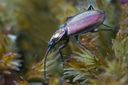
Agonum belleri is a flightless ground beetle to Pacific Northwest wetlands. It is metallic-black with , blue, or green reflections. The is restricted to sphagnum bogs and associated wetlands in Oregon, Washington, and British Columbia. It is listed as endangered by the Xerces Society and a species of greatest conservation need in Washington due to loss from peat mining and development.
Pronunciation
How to pronounce Agonum belleri: /əˈgoʊnəm ˈbɛlɛraɪ/
These audio files are automatically generated. While they are not always 100% accurate, they are a good starting point.
Identification
Distinguished from other Agonum by combination of metallic coloration, flightless condition with grooved , and restriction to sphagnum bog . The bristles, visible only under magnification or proper lighting, may aid identification. Similar Platyninae species in the region lack this specific habitat association and color pattern.
Images
Appearance
Metallic-black body with tone, often reflecting blue or green. Winged but flightless. have vertical grooved . surface covered with bristles visible under proper lighting or magnification.
Habitat
Sphagnum bogs at low to medium elevations; rarely other wetlands and moist woods. In Washington, primarily in Puget Trough sphagnum moss. Associated vegetation includes common cotton sedge, sundew, bog cranberry, Labrador tea, bog rosemary, bigleaf maple, firs, western redcedar, and red alder. Soil composition is critical for breeding and development.
Distribution
Pacific Northwest of North America: Oregon (northwest), Washington, and British Columbia (southwest and Charlotte Islands). Recorded from Mt. Hood National Forest; purportedly present in Baker National Forest, Olympic National Forest, and around Mt. St. Helens.
Seasonality
Activity increases during warmer periods and summer months, when highest numbers are observed.
Diet
Predatory; feeds on other insects. hunt by sight during the day using fast running and powerful . Adults consume more plant material than larvae.
Life Cycle
Complete : , larva, pupa, . Females lay eggs singly in shallow soil burrows. Larvae and pupae develop underground. Multi-year lifespan; larvae may take several years to fully develop.
Behavior
that hunts by sight. Fast runner with powerful for subduing prey. Activity increases with warmer temperatures.
Ecological Role
in sphagnum bog . Contributes to in wetland .
Human Relevance
Conservation concern due to restricted . Listed as endangered by Xerces Society for Conservation and of greatest conservation need by Washington Department of Fish and Wildlife. Threatened by habitat loss, peat mining, and use. Named after Samuel Beller, entomologist and pupil of Melville H. Hatch.
Similar Taxa
- Other Agonum speciesLack specific metallic coloration with /blue/green reflections, flightless condition with grooved , and strict sphagnum bog association
- Other Platyninae ground beetlesDiffer in preference; A. belleri is restricted to Pacific Northwest sphagnum bogs
More Details
Conservation Status
Not evaluated by IUCN. Listed as endangered by Xerces Society for Conservation. Designated of greatest conservation need by Washington Department of Fish and Wildlife. Sphagnum bogs comprise only 3% of Washington wetlands, making extremely limited.
Etymology
Named after Samuel Beller, entomologist and pupil of Melville H. Hatch.