
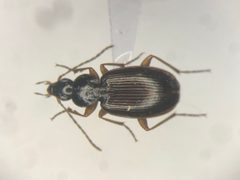
Agonum retractum
LeConte, 1846
A wing polymorphic ground beetle found in aspen woodlands of the Canadian Rockies and across North America. Females exhibit both short-winged and long-winged morphs, with the long-winged form capable of until triggers flight muscle . Males are predominantly short-winged. The has been studied for its role in chemical cycling within forest and its in stable, non-migratory populations.
Pronunciation
How to pronounce Agonum retractum: //əˈɡoʊnəm rɪˈtræktəm//
These audio files are automatically generated. While they are not always 100% accurate, they are a good starting point.
Images
Habitat
Aspen woodland in montane regions, particularly in the Canadian Rockies. Occurs in stable where is minimal or absent.
Distribution
North America: Canada and the United States. Documented from the Kananaskis Valley of Alberta, with broader distribution across the continent.
Behavior
activity pattern inferred from congeneric studies in turfgrass . Wing dimorphism in females appears maintained by heterozygote advantage, with long-winged heterozygous females potentially serving as more efficient colonizers by producing mixed progeny. ability in long-winged females ceases between mating and development due to flight muscle .
Ecological Role
Contributes to chemical cycling in aspen woodland . Functions as a within the ground beetle , though specific prey relationships remain undocumented.
Similar Taxa
- Agonum ericetiBoth are bog and wetland ground beetles in the Agonum; A. ericeti is specifically associated with Sphagnum moss in peat bogs, whereas A. retractum occupies aspen woodlands.
Sources and further reading
- BugGuide
- Wikipedia
- GBIF taxonomy match
- iNaturalist taxon
- NCBI Taxonomy
- Don't get bogged down with peat... - Buglife Blog - Buglife
- Clues in the Clay: Decoy Insect Larvae Reveal Predator Presence in Turfgrass
- beetle and caterpillar clay models - Entomology Today
- Wing polymorphism in the insect species Agonum retractum Leconte (Coleoptera: Carabidae)
- Agonum retractum (Coleoptera: Carabidae) in an Aspen woodland in the Canadian Rockies: population biology and chemical cycling