
Dromius
Bonelli, 1810
Species Guides
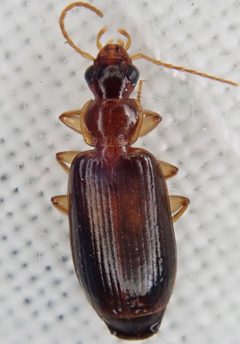
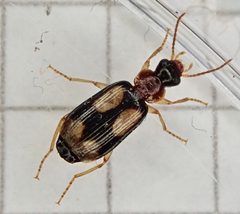
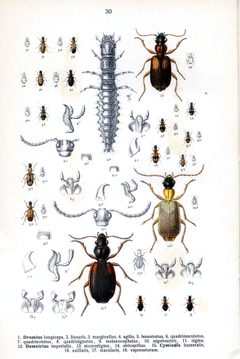
2Dromius is a of small arboreal ground beetles in the Carabidae, comprising approximately 108 distributed across the Palearctic, Nearctic, Near East, and North Africa. Members of this genus are characterized by their tree-dwelling habits, inhabiting trunks and bark of deciduous and coniferous trees rather than ground-level environments. The genus includes the well-studied species Dromius quadrimaculatus, known as the Great Four-spot Treerunner, which has served as a model for understanding -dwelling carabid .
Pronunciation
How to pronounce Dromius: //ˈdro.mi.us//
These audio files are automatically generated. While they are not always 100% accurate, they are a good starting point.
Identification
Small beetles, 5–6.4 mm in length. Dromius quadrimaculatus specifically displays four pale elytral spots, with spots extending to the hind elytral margin; notably larger than similar spotted arboreal carabids and lacking the basal pore-puncture present in related .
Images
Habitat
Arboreal; found on tree trunks and under bark, predominantly on deciduous trees including sycamore, alder, willow, lime, apple, and ash, with records also from spruce. Present year-round under bark and among lichen and moss on trunks. Absent from ground-level sampling; dominates catches in temperate forests.
Distribution
Native to the Palearctic (including Europe), the Nearctic, the Near East, and North Africa. Widespread across Europe including Great Britain and Ireland; frequent in England and Wales, more local in Scotland and Ireland.
Seasonality
Activity peaks in late July to early August based on trapping studies; and larvae can be encountered throughout the year under tree bark.
Diet
Predatory on small arthropods.
Life Cycle
and larvae present year-round; no specific reproductive details documented.
Behavior
Strictly arboricolous (tree-dwelling) ; absent from ground pitfall traps. In -crane studies, represented approximately 70% of carabids in canopy traps.
Ecological Role
component of carabid in temperate floodplain forests; significant in arboreal microhabitats.
Human Relevance
Dromius quadrimaculatus sequenced as part of the Darwin Tree of Life Project, providing the first high-quality reference genome for the (778.78 Mb assembly, 95.73% scaffolded into 14 chromosomal pseudomolecules).
Similar Taxa
- Related arboreal carabid generaDromius quadrimaculatus is larger than similar spotted arboreal carabids and lacks the basal pore-puncture characteristic of related .