
Harpalus rubripes
(Duftschmid, 1812)
Red-legged Harpalus
Harpalus rubripes is a medium-sized ground beetle in the Harpalinae, characterized by its distinctive reddish legs that give the its name. Native to the Palearctic region, it has established across much of Europe, extending eastward through Siberia and Central Asia to Anatolia. The species was introduced to North America, with records dating from 1987 onward. Like other members of the Harpalus, it is primarily and ground-dwelling.
Pronunciation
How to pronounce Harpalus rubripes: //ˈhɑːr.pə.ləs ˈruː.brɪˌpɛs//
These audio files are automatically generated. While they are not always 100% accurate, they are a good starting point.
Identification
Distinguished from similar Harpalus by the combination of reddish legs (especially tibiae and ), dark body coloration, and body proportions. Most similar to H. affinis and H. distinguendus, but leg coloration is more pronounced in H. rubripes. Examination of male genitalia may be necessary for definitive identification in areas where multiple occur. The introduced North American can be identified by the same characters, though they may show some reduction in size compared to European specimens.
Images
Appearance
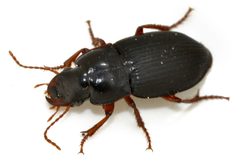
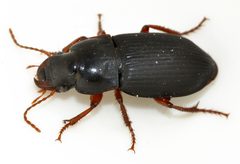
Medium-sized ground beetle, typically 12-15 mm in length. Body elongate-oval, moderately convex. dark brown to black with distinct . Pronotum somewhat transverse, narrower than elytra at base. , extending beyond pronotal base. Legs notably reddish-orange, especially the tibiae and , providing the specific epithet 'rubripes' (red-footed). with prominent and well-developed typical of predatory carabids.
Habitat
Open, dry to moderately moist including agricultural fields, grasslands, areas, and forest edges. Shows preference for sandy or loamy soils with sparse vegetation cover. Often found in anthropogenic habitats such as cultivated fields, gardens, and roadside verges. In North America, established in similar open, disturbed habitats.
Distribution
Native to the Palearctic: Europe (widespread), east through Siberia, Central Asia, and Anatolia (Turkey). Introduced to North America, with established in the northeastern United States and eastern Canada. First recorded in North America in 1987, with subsequent spread.
Seasonality
active primarily from spring through autumn, with peak activity in summer months. occurs as adults in sheltered locations. In temperate regions, activity period typically April-October, though this varies with latitude and local climate conditions.
Behavior
ground-dwelling , spending daylight hours concealed under stones, debris, or in soil crevices. Emerges at dusk to forage. Capable of but primarily runs across ground surface. When disturbed, exhibits typical carabid defense of rapid running or short flight to escape. Aggregates in suitable microhabitats, particularly under cover objects.
Ecological Role
and scavenger in ground-level . Contributes to of pest insects in agricultural systems. As a granivorous ground beetle, may also consume weed seeds, potentially aiding in weed suppression. Serves as prey for larger and vertebrates including birds, small mammals, and predatory insects.
Human Relevance
Considered beneficial in agricultural contexts due to on pest insects and weed seed consumption. No significant negative impacts documented. Occasionally enters buildings but not considered a household pest. Subject of ecological studies examining ground beetle responses to farming practices, including tillage regimes.
Similar Taxa
- Harpalus affinisSimilar size and body shape, but typically has darker legs and more pronounced elytral microsculpture
- Harpalus distinguendusOverlapping distribution and preferences; distinguished by leg coloration and subtle differences in pronotal shape
- Harpalus rufipesVery similar appearance and also has reddish legs; historically confused with H. rubripes but now recognized as distinct with different distribution
More Details
North American Introduction
First documented in North America in 1987, with initial records from the northeastern United States. The introduction is uncertain but likely associated with human transport via shipping or agricultural products. Established now occur across multiple states and provinces, with the showing capacity for continued range expansion.
Taxonomic History
Originally described as Carabus rubripes by Duftschmid in 1812, later transferred to Harpalus. The has undergone various taxonomic revisions, with some former synonyms now recognized as distinct species (e.g., separation of H. rufipes from H. rubripes).
Sources and further reading
- BugGuide
- Wikipedia
- GBIF taxonomy match
- iNaturalist taxon
- NCBI Taxonomy
- Beneficial Beetle Diversity Blooms on Strip-Tilled Farms
- T.G.I.Flyday—Black horse fly (Tabanus atratus) | Beetles In The Bush
- November | 2012 | Beetles In The Bush | Page 2
- conservation | Beetles In The Bush
- Carabidae | Beetles In The Bush
- Bug of the Week