
Harpalus affinis
Ballion, 1878
Metallic Harpalus
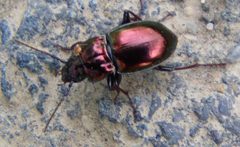
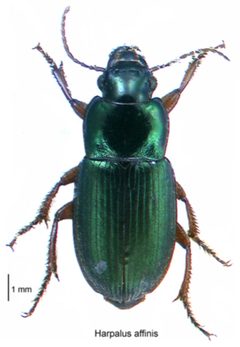
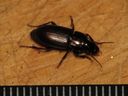
Harpalus affinis is a ground beetle native to the Palearctic region, with established introduced in North America and New Zealand. measure 8.5–12 mm and display distinctive metallic bronze, green, or blue reflections on an otherwise black body. The species has been documented as part of beneficial ground beetle in agricultural systems, where it responds positively to reduced-tillage practices. Larval development spans approximately three months, with newly hatched larvae emerging in mid-May.
Pronunciation
How to pronounce Harpalus affinis: /ˈhar.pa.lus əˈfɪ.nɪs/
These audio files are automatically generated. While they are not always 100% accurate, they are a good starting point.
Images
Distribution
Native to the from Europe through Siberia. Introduced and established in North America (present in Canadian provinces from British Columbia to the Maritimes, and the United States) and New Zealand (first recorded mid-to-late 1970s). In Europe, absent from numerous islands and small territories including the Azores, Canary Islands, Channel Islands, Crete, Cyclades, Dodecanese, Faroe Islands, Franz Josef Land, Gibraltar, Iceland, Madeira, Malta, Monaco, North Aegean islands, Novaya Zemlya, San Marino, Savage Islands, Sicily, Svalbard and Jan Mayen, and Vatican City. Presence on the Balearic Islands and Sardinia is uncertain.
Seasonality
Larval hatching occurs in mid-May.
Life Cycle
Newly hatched larvae measure 4 mm with orange and dark grey abdominal tips. Second instar larvae reach approximately 10 mm, with large dark orange , head, and pronotum; light grey. Legs possess large orange . Developmental period lasts three months.
Human Relevance
Has been documented in studies of beneficial ground beetle diversity in agricultural systems, where strip tillage practices were found to be less disruptive to compared to plasticulture production.
Sources and further reading
- BugGuide
- Wikipedia
- GBIF taxonomy match
- iNaturalist taxon
- NCBI Taxonomy
- Catalogue of Life
- Meet 'Mantis Master Keeper' Andrew Pfeifer | Bug Squad
- Saving the Rusty-Patched Bumble Bee | Bug Squad
- Take 2 on tropical tiger moths: Spotted oleander caterpillar moth, Empyreuma affinis — Bug of the Week
- Mason bees in peril when parasitic wasps arrive – Leucospid wasp, Leucospis affinis — Bug of the Week
- A Tick that Feeds on Birds May Increase the Range of Lyme Disease
- Beneficial Beetle Diversity Blooms on Strip-Tilled Farms