
Harpalus rufipes
(DeGeer, 1774)
strawberry seed beetle
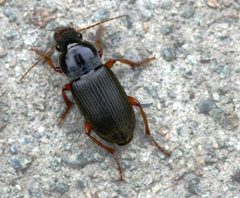
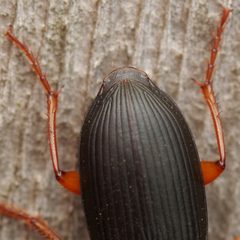
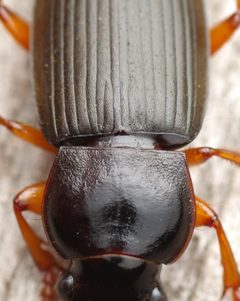
Harpalus rufipes is a trans-palearctic ground beetle commonly known as the strawberry . are active from April through November in temperate regions. The functions as a significant weed seed in agricultural , with larvae and adults feeding on seeds of various grasses and agricultural crops. It has been widely studied as a agent for weed management and serves as a for multiple including the braconid Microctonus caudatus and the gregarine protozoan Clitellocephalus ophoni.
Pronunciation
How to pronounce Harpalus rufipes: /ˈhɑr.pə.ləs ˈru.fɪ.pɛs/
These audio files are automatically generated. While they are not always 100% accurate, they are a good starting point.
Images
Habitat
Agricultural , forest plantations, and field margin ; described as a polyzonal habitat . In agricultural settings, shows preference for systems with vegetative cover such as pea/oat–rye/vetch cover crops over bare . Found in strawberry fields, wheat and other grain crop fields, and disturbed soils with seed resources.
Distribution
Trans-palearctic distribution across the temperate zone of Eurasia. Native to Europe with records from France, Poland, Ukraine, and other European countries. Introduced or established in North America with records from Canada and the USA.
Seasonality
active from April until November in temperate regions. Overwintered males predominate early in the season until May, followed by overwintered females in June and July. Newly emerged adults, mainly female, appear from August onwards.
Diet
Mixed phytophage and seed . and larvae feed on seeds of grasses and agricultural crops including Triticum aestivum (wheat), Hordeum vulgare (barley), Secale cereale (rye), Avena sativa (oats), Panicum miliaceum (millet), Sorghum drummondii, Fagopyrum esculentum (buckwheat), Sinapis arvensis (wild mustard), Chenopodium album (lamb's quarters), and Beta vulgaris. Poorly digests high-fat seeds such as Juglans regia (walnut) due to fat droplet obstruction. Larvae store seeds in vertical burrows for later consumption.
Host Associations
- Microctonus caudatus - braconid that parasitizes beetles; summer occurs in up to 27% of with mean of 8.4%. Up to 92 larvae per host, invariably killing the host upon .
- Clitellocephalus ophoni - Eugregarine protozoan inhabiting the intestines; approximately 1% in Polish , with overall gregarine prevalence of 8%.
Life Cycle
Overwintered females mature during early summer and lay in August with of 10–15 eggs per female. First- and second-instar larvae active in autumn, constructing approximately vertical burrows in soil to store seeds collected from the surface. Third-instar larvae remain in burrows feeding on stored seeds and are not active on the surface. Larvae typically aggregated at soil densities of 3–20 per square meter. About 30% of survive from one breeding season to the next under laboratory conditions.
Behavior
or activity pattern typical of ground beetles. Shows -independent ; field experiments found no consistent trend of increased dispersal at higher densities, suggesting interference competition does not drive . Strong preference for vegetated cover over bare soil; marked beetles released into plots were more than twice as likely to move to vegetated plots than vice versa.
Ecological Role
Important weed seed and agent in agricultural . Functions as a polyphage regulating trophic chains through seed consumption. Contributes to weed seedbank depletion in crop fields, particularly in systems with cover crops and reduced tillage. Serves as for and protozoan , supporting higher .
Human Relevance
Used as a agent to manage weed seedbanks in agricultural systems. Research indicates that strip tillage and cover crop systems (particularly pea/oat–rye/vetch) support higher , enhancing natural weed suppression. Has been used as a model organism for studies of immune systems and sensitivity to environmental contaminants including engine oil and diesel oil.
Sources and further reading
- BugGuide
- Wikipedia
- GBIF taxonomy match
- iNaturalist taxon
- NCBI Taxonomy
- Catalogue of Life
- Vanquished vanishing columbines: Columbine sawfly, Pristiphora rufipes — Bug of the Week
- Beneficial Beetle Diversity Blooms on Strip-Tilled Farms
- And the winner is… | Beetles In The Bush
- T.G.I.Flyday—Black horse fly (Tabanus atratus) | Beetles In The Bush
- Fungus Manipulates Ants to Die Near their Nests, Ensuring New Hosts
- Bug Eric: More Beetles from Bones
- The biology of the ground beetle Harpalus rufipes in a strawberry field in Northumberland
- Possibility of identifying plant components of the diet of Harpalus rufipes (Coleoptera, Carabidae) by visual evaluation
- Habitat effects on second-order predation of the seed predator Harpalus rufipes and implications for weed seedbank management
- Potential Bioclimatic Ranges of Crop Pests Zabrus tenebrioides and Harpalus rufipes during Climate Change Conditions
- Cover Crop Effects on the Activity-Density of the Weed Seed PredatorHarpalus rufipes(Coleoptera: Carabidae)
- Behavioural Studies ofHarpalus rufipesDe Geer: an Important Weed Seed Predator in Northeastern US Agroecosystems
- The biology of Microctonus caudatus (Thomson), a braconid parasite of the ground beetle Harpalus rufipes (Degeer)
- Clitellocephalus ophoni (Tuzet et Ormières, 1956) (Apicomplexa: Eugregarinida: Gregarinidae) recorded in Poland on strawberry seed beetle Harpalus ( Ophonus ) rufipes (De Geer, 1774) (Coleoptera: Carabidae)
- Is dispersal density‐dependent in carabid beetles? A field experiment with Harpalus rufipes (Degeer) and Pterostichus niger (Schaller) (Col., Carabidae)
- Distribution, Dispersal and Population Size of the Ground Beetles,Pterostichus melanarius(Illiger) andHarpalus rufipes(Degeer) (Coleoptera, Carabidae), in Field Margin Habitats
- Morphometric variability of Clitellocephalus ophoni (Eugregarinida, Gregarinidae) in the intestines of Harpalus rufipes (Coleoptera, Carabidae)
- The genome sequence of a ground beetle, Harpalus rufipes (DeGeer, 1774).