
Elaphrus viridis
G.Horn, 1878
Delta Green Ground Beetle
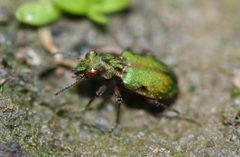
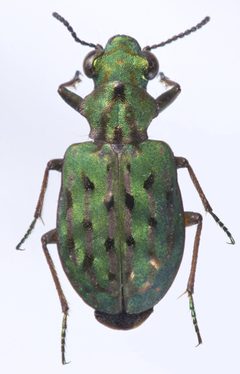
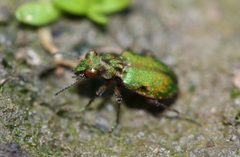
Elaphrus viridis is a small, metallic-green ground beetle to a restricted region in Solano County, California. It is closely associated with vernal pool , where its is tied to seasonal flooding and drying patterns. The is federally listed as threatened and IUCN Critically Endangered due to its extremely limited range and habitat loss. are active during the wet season, emerging in January and becoming by May when pools dry.
Pronunciation
How to pronounce Elaphrus viridis: /ɛˈlæf.rəs ˈvɪr.ɪ.dɪs/
These audio files are automatically generated. While they are not always 100% accurate, they are a good starting point.
Identification
Distinguished from other Elaphrus by the lack or reduction of circular pits on the . The metallic green coloration with bronze spots separates it from most other ground beetles in its range. Its small size and vernal pool association provide additional diagnostic context. Similar superficial appearance to tiger beetles (Cicindelinae), but Elaphrus lacks the characteristic large and elongated legs of that .
Images
Habitat
Vernal pool grasslands and adjacent upland areas. Specifically associated with the edges of vernal pools, nearby trails, roads, and ditches. Occupies open with low vegetation where it can utilize camouflage against spring grass. Surrounding grasslands may also support , though detection is difficult due to the 's cryptic .
Distribution
to Solano County, California, USA. Restricted to the Jepson Prairie region south of Dixon. Historically may have occurred more broadly throughout the Central Valley, but current confirmed range is extremely limited. Protected at Jepson Prairie Preserve; other known localities occur on public land.
Seasonality
emerge in January following winter rains that fill vernal pools. Active through the wet season until entering dormancy in approximately May, coinciding with pool desiccation. This seasonal pattern represents an to Mediterranean climate conditions and vernal pool hydrology.
Diet
Actively hunts soft-bodied arthropods. Based on congeneric feeding habits, likely preys primarily on springtails (Collembola), though this specific dietary preference has not been directly confirmed for E. viridis.
Life Cycle
with one per year. Females produce offspring during the active season from January through September. Developmental stages correspond to the availability of vernal pool , with dormancy during the dry summer months.
Behavior
Cryptic including hiding beneath low vegetation. Difficult to detect due to small size, coloration matching spring grass, and tendency to remain concealed. Active forager during wet season months.
Human Relevance
Subject to federal protection as a threatened since 1980. Conservation focus for vernal pool preservation in California. loss from agricultural development, urbanization, and grazing represents primary threat. Garden lippia ( nodiflora) poses additional risk by forming dense mats that impede foraging.
Similar Taxa
- Elaphrus californicus and other congenersDistinguished by reduced circular pits on ; other Elaphrus typically possess more prominent elytral punctation
- Cicindelinae (tiger beetles)Superficially similar in appearance and preference, but tiger beetles have larger , longer legs, and more active predatory ; Elaphrus has reduced eyes and shorter legs adapted for ground-dwelling in dense vegetation
More Details
Conservation Status
IUCN Critically Endangered; federally listed as threatened in the United States since 1980. The ' survival is directly tied to preservation of vernal pool , which have experienced significant losses in California due to agricultural conversion and urban development.
Etymology
Specific epithet 'viridis' derives from Latin for green, referencing the characteristic metallic green coloration of .
Sources and further reading
- BugGuide
- Wikipedia
- GBIF taxonomy match
- iNaturalist taxon
- Catalogue of Life
- Green Light: New ID Test Ready for Invasive Mealybug Pest
- Here We Go Again: Another Invasive Pest in Florida Citrus
- A First Class Box of Beetles | Beetles In The Bush
- Small but Destructive: Hibiscus Mealybug Emerges as Concerning Pest of Florida Fruits, Ornamentals, Some Row Crops
- Cicindela scutellaris lecontei x scutellaris unicolor intergrades in southeast Missouri | Beetles In The Bush
- Geographic Distribution and Habitat Characterization of the Threatened Delta Green Ground Beetle, Elaphrus viridis Horn, 1878 (Coleoptera: Carabidae), in the Jepson Prairie Region of Solano County, California, USA