
Tetracha
Hope, 1838
Metallic Tiger Beetles
Species Guides
4- Tetracha carolina(Carolina Metallic Tiger Beetle)
- Tetracha floridana(Florida metallic tiger beetle)
- Tetracha impressa(Upland Metallic Tiger Beetle)
- Tetracha virginica(Virginia Metallic Tiger Beetle)
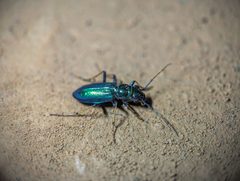
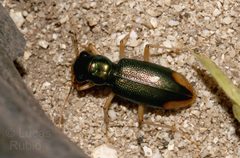
Tetracha is a of metallic tiger beetles in the , containing approximately 100 described . The genus was formerly treated as a subgenus of Megacephala but was elevated to full generic status based on morphological and molecular evidence. Tetracha species are exclusively New World in distribution, contrasting with the Old World distribution of Megacephala. Four species occur in the United States: T. carolina, T. floridana, T. virginica, and T. impressa.
Pronunciation
How to pronounce Tetracha: /tɛˈtra.kə/
These audio files are automatically generated. While they are not always 100% accurate, they are a good starting point.
Identification
can be distinguished from other Nearctic tiger by their activity, metallic coloration, and large . Tetracha floridana is distinguished from T. carolina by divergent lobes of the lunules and uniformly black to dark green lacking violet or coppery reflections. T. virginica is distinguished by solid green elytra without apical markings. Larvae are identified by simple, thorn-like outer hooks on the fifth abdominal hump (other eastern U.S. genera have distinctly curved outer hooks), white pronotal margin, and nearly equal-sized simple .
Images
Habitat
vary by . Tetracha floridana occurs in salt marsh and mud flat habitats along the Gulf coast of Florida. Tetracha virginica occupies diverse habitats including bottomland forests and is widespread throughout the southern two-thirds of the eastern U.S. Tetracha carolina occurs in disturbed, sparsely vegetated areas and agricultural fields with clay/loam soils. Larval burrows are found in moist to dry soils, often in vegetated areas rather than completely bare ground.
Distribution
Exclusively New World. Approximately 100 described distributed from the United States through Central and South America. In the United States, four species occur: T. carolina (southeastern states, north to Missouri), T. floridana (Florida Gulf coast, ), T. virginica (widespread in eastern U.S., southern two-thirds), and T. impressa (southern Texas and northern Mexico).
Seasonality
are strictly and have been observed active at night, including at street lamps and building lights. Activity patterns vary by and locality.
Diet
are predatory, feeding on ground-surface arthropods including insects such as corn rootworm larvae. They are fluid feeders: subdue and shred prey while and masticate tissues into a bolus, which is then liquified by proteolytic from the and ingested via a pharyngeal pump. Larvae are sit-and-wait that seize passing prey from burrow entrances.
Life Cycle
Larvae construct vertical burrows in soil, with third instar burrows approximately 8 mm in diameter. Larvae lie at burrow entrances to ambush prey, using abdominal hump hooks for traction. Development includes , larval (three instars), pupal, and stages. Rearing studies indicate development from third instar to adult can be completed in approximately two months under favorable conditions.
Behavior
are strictly and fast-moving. They are frequently attracted to artificial lights at night. When approached, adults dash rapidly into vegetation. Females oviposit in soil among sparse vegetation, excavating holes with an eversible ovipositor. Larvae are sit-and-wait that remain at burrow entrances for limited periods, retreating when disturbed.
Ecological Role
of ground-surface arthropods. Larvae and function as predators in their respective .
Human Relevance
Subject of entomological study due to taxonomic history and larval . Some attracted to building and street lights, bringing them into human notice. Occasionally collected for study or photography.
Similar Taxa
- MegacephalaFormerly included Tetracha as a subgenus; distinguished by Old World distribution (Africa, Palearctic, Australia) versus exclusively New World distribution in Tetracha
- Cicindela activity versus strictly in Tetracha; larvae have curved outer hooks on abdominal hump versus simple thorn-like hooks in Tetracha
- AmblycheilaAlso has simple hooks on larval hump, but inner and outer hooks are distinctly separated; second pair of distinctly smaller than first pair versus nearly equal in Tetracha
- OmusAlso has simple hooks, but bears three pairs rather than two pairs on larval hump; restricted to Pacific Coast versus broader distribution in Tetracha
More Details
Taxonomic History
The classification of Tetracha and related was disputed for over a century. Walter Horn (1910) united most world under Megacephala, but Huber (1994) resurrected Tetracha for New World . Naviaux (2007) formally elevated all seven former subgenera of Megacephala to full generic status, supported by molecular phylogenetic analysis (Zerm et al. 2007). Molecular data indicate three monophyletic clades: African/Palearctic (Megacephala, Grammognatha), Western Hemisphere (Tetracha, Aniara, Metriocheila, Phaeoxantha), and Australian (Australicapitona, Pseudotetracha), consistent with Gondwanan vicariance.
Larval Identification
Larval stages remain undescribed for many . Tetracha floridana and T. impressa larvae were undescribed in the literature as of 2011. Diagnostic larval characters include hook on the fifth abdominal segment, pronotal margin coloration, size ratios, and setal patterns on abdominal plates.
Sources and further reading
- BugGuide
- Wikipedia
- GBIF taxonomy match
- iNaturalist taxon
- NCBI Taxonomy
- Catalogue of Life
- The Third of Florida’s Three Metallic Tiger Beetles | Beetles In The Bush
- Florida Metallic Tiger Beetle | Beetles In The Bush
- Why I Roamed the Marsh at Night | Beetles In The Bush
- A “Really” Big-headed Tiger Beetle | Beetles In The Bush
- Eye to eye to eye to eye with a tiger beetle larva | Beetles In The Bush
- Laboratory Evaluation ofTetracha carolina(Coleoptera: Carabidae: Cicindelinae) as a Predator of Ground-Surface Arthropods in an Old-Field Habitat