
Habroscelimorpha dorsalis media
(LeConte, 1856)
White Beach Tiger Beetle
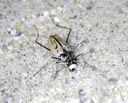
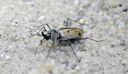
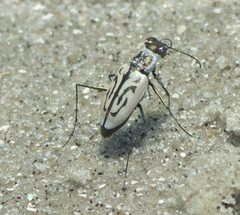
Habroscelimorpha dorsalis media is a of tiger in the Carabidae, commonly known as the White Beach Tiger Beetle. This subspecies inhabits coastal sand dune environments where it exhibits specialized for survival in sandy . The larvae of this subspecies display a distinctive defensive behavior: when disturbed, they leap from their burrows, grasp their tail with their , and allow wind to roll them wheel-like across the sand surface. This rolling escape mechanism has been documented on barrier island dunes off the coast of Georgia.
Pronunciation
How to pronounce Habroscelimorpha dorsalis media: /ˌhæb.roʊˌskɛ.lɪˈmɔr.fə ˈdɔr.sə.lɪs ˈmɛ.di.ə/
These audio files are automatically generated. While they are not always 100% accurate, they are a good starting point.
Identification
Distinguished from other tiger beetles by specificity to coastal sand dunes and the unique larval of wind-assisted wheel-rolling when disturbed. may be distinguished from related by subtle differences in elytral maculations and coloration, though specific diagnostic features require expert examination.
Images
Habitat
Coastal sand dune environments on barrier islands; specifically documented from sandy beach and dune systems along the Georgia coast. Requires loose, wind-swept sand for larval burrow construction and the wheel-rolling escape .
Distribution
Documented from barrier islands off the coast of Georgia, USA; broader distribution within the southeastern United States coastal region likely but not confirmed in available sources. GBIF records indicate presence in USA, Cuba, Mexico, and Middle America, though these may represent the full H. dorsalis rather than this specifically.
Seasonality
activity period not specifically documented for this ; likely active during warmer months typical of tiger beetles in temperate coastal regions.
Life Cycle
Larvae construct burrows in sandy substrate; when threatened, larvae exit burrows and execute a rolling escape response using wind propulsion. Complete with , larval, pupal, and stages; specific developmental timing not documented.
Behavior
Larvae exhibit a distinctive escape when disturbed: leaping from burrows, grasping the terminal abdominal segment with , and rolling wheel-like across sand surfaces when propelled by wind. This behavior was first documented in a 2012 study and represents a rare example of wind-assisted locomotion in insects. are fast-running typical of tiger beetles.
Ecological Role
Predatory insect in coastal dune ; larvae and likely contribute to regulation of small in sandy beach . Specific ecological interactions not documented.
Human Relevance
Subject of scientific research due to unique larval locomotory ; contributes to understanding of behavioral adaptations in extreme environments. Not documented as a significant pest or beneficial in agricultural or public health contexts.
Similar Taxa
- Habroscelimorpha dorsalis dorsalisNominotypical ; distinguished by geographic distribution and subtle morphological differences in maculation patterns
- Cicindela arenicolaAnother sand-dwelling tiger with similar preferences; distinguished by coloration (coppery red to greenish red in C. arenicola) and different larval
- Cicindela theatinaSimilar appearance to some H. dorsalis ; requires expert examination of elytral patterns and body proportions for reliable separation
More Details
Wheel-Rolling Behavior Research
The distinctive larval of H. dorsalis media was documented in a 2012 study by Harvey and Zukoff published in PLoS ONE. This behavior represents one of few documented cases of wind-assisted active locomotion in insects, where the larva voluntarily creates a wheel-like posture and uses wind energy for rapid displacement across sand surfaces.
Taxonomic History
Originally described as Cicindela dorsalis media by LeConte in 1856; subsequently transferred to Habroscelimorpha following taxonomic revisions of tiger classification. Some sources list as reflecting alternative family-level classifications.
Sources and further reading
- BugGuide
- GBIF taxonomy match
- iNaturalist taxon
- NCBI Taxonomy
- Catalogue of Life
- Scorched locust - Locust leafminer, Odontota dorsalis — Bug of the Week
- ID Challenge #13 – Addendum | Beetles In The Bush
- Discovery of wasp species previously unknown in the U.S.
- White-Eyed Fruit Flies: How Improvements in Gene Editing Could Aid in Pest Management
- Scorched locust, courtesy of the Locust leafminer, Odontota dorsalis — Bug of the Week