
Cicindelidia trifasciata
(Fabricius, 1781)
S-banded Tiger Beetle, Ascendent Tiger Beetle (subspecies)
Species Guides
2- Cicindelidia trifasciata ascendens(Ascendent Tiger Beetle)
- Cicindelidia trifasciata sigmoidea(Mudflat Tiger Beetle)
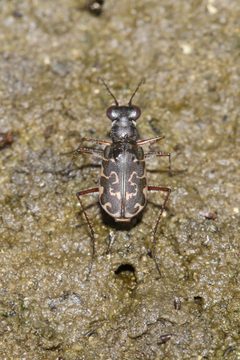
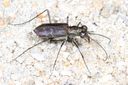
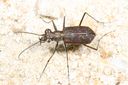
Cicindelidia trifasciata is a of tiger known as the S-banded Tiger Beetle, characterized by dark brown coloration and a thin, sinuous, S-shaped middle elytral maculation. The species includes a recognized , C. trifasciata ascendens (Ascendent Tiger Beetle), which inhabits coastal salt marsh environments. are , extremely active and flighty, particularly in hot conditions. The species has been documented across a broad geographic range including the southern United States, Caribbean islands, and South America.
Pronunciation
How to pronounce Cicindelidia trifasciata: /ˌsɪsɪndɛˈlɪdiə ˌtraɪˌfæsɪˈeɪtə/
These audio files are automatically generated. While they are not always 100% accurate, they are a good starting point.
Identification
Recognized by dark brown coloration combined with the thin, sinuous, S-shaped middle maculation on the . Distinguished from sympatric tiger beetles in salt marsh by this specific maculation pattern and coloration. In coastal Florida, differs from Ellipsoptera by the S-shaped (not diffuse) middle maculation, and from Habroscelimorpha severa by its dark brown (not shiny green) coloration and more extensive maculations.
Images
Habitat
Coastal salt marshes and tidal flats with moist, saline substrates. The C. t. ascendens is specifically associated with these coastal wetland environments, occurring on areas of the flats close to the water's edge. Also found in barren sand exposures along roadsides in appropriate coastal regions.
Distribution
Broad distribution spanning the southern United States (including Florida, Texas, and Missouri where vagrants have been recorded), Caribbean islands (Cayman Islands, Cuba), and South America (Colombia, Ecuador). Also recorded from the Galápagos Islands. The C. t. ascendens occurs along the Gulf Coast of Florida and Texas.
Seasonality
active during summer months; activity continues into late afternoon and early evening in hot conditions. Peak abundance at coastal sites appears to occur mid-season, with activity declining by late summer/early autumn.
Behavior
are extremely active and flighty, particularly during hot conditions. Difficult to approach closely for observation or photography due to rapid escape . Activity continues through late afternoon when heat persists. Has been observed as a vagrant well outside its normal range, suggesting capability.
Ecological Role
Predatory in coastal wetland . Co-occurs with multiple other tiger beetle in salt marsh , contributing to local biodiversity.
Human Relevance
Subject of interest to tiger enthusiasts and collectors; the 'Road to Nowhere' locality in Florida is renowned among collectors for high tiger beetle diversity including this . Sometimes collected as voucher specimens for documentation.
Similar Taxa
- Habroscelimorpha severaShares coastal salt marsh but distinguished by shiny green coloration and maculations reduced to small spots at middle and rear of .
- Ellipsoptera hamataCo-occurs along Gulf Coast but has diffuse (not S-shaped) middle maculation and different elytral apex structure.
- Ellipsoptera marginataCo-occurs along Gulf Coast but has diffuse middle maculation and distinctive downbent elytral apices in females.
More Details
Subspecies
Cicindelidia trifasciata ascendens (Ascendent Tiger Beetle) is a recognized restricted to coastal salt marsh of the Gulf Coast.
Vagrant records
A single vagrant individual was documented in southern Missouri, well outside the normal range, indicating potential for long-distance .