
Cicindelidia trifasciata ascendens
(LeConte, 1852)
Ascendent Tiger Beetle, Three-lined Tiger Beetle
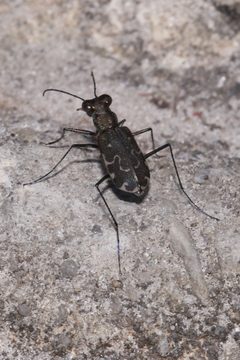
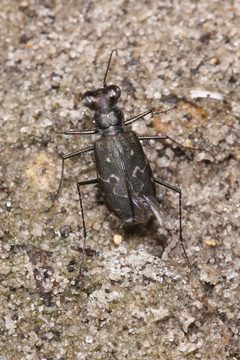
Cicindelidia trifasciata ascendens is a of tiger commonly found in coastal salt marsh along the Gulf Coast of Florida. It is recognized by its dark brown coloration and distinctive thin, sinuous, S-shaped middle elytral maculation. The subspecies is notably active and flighty, particularly during hot afternoon conditions. It has been documented as far north as Missouri as a rare vagrant, but its core range centers on saline coastal wetlands from Texas through Florida.
Pronunciation
How to pronounce Cicindelidia trifasciata ascendens: /sɪˌsɪndɛˈlɪdiə traɪˌfæsiˈeɪtə əˈsɛnˌdɛnz/
These audio files are automatically generated. While they are not always 100% accurate, they are a good starting point.
Identification
Distinguished from co-occurring salt marsh tiger beetles by the combination of dark brown coloration and the characteristic thin, sinuous, S-shaped middle elytral maculation. Habroscelimorpha severa, which shares the saline , has a shiny green surface with maculations reduced to small spots at the middle and rear of the . Eunota togata togata has more extensive pale markings. The dark brown coloration separates it from the typically brighter green or brown of Ellipsoptera.
Images
Appearance
Dark brown coloration overall. bear a thin, sinuous, S-shaped middle maculation that is diagnostic for the . The dark coloration contrasts with the pale, wavy elytral marking. Body form typical of tiger beetles with large, prominent and long, slender legs adapted for rapid running.
Habitat
Coastal salt marshes and tidal wetlands with moist, saline substrates. Found on areas of the flats close to the water's edge, particularly on barren, wet, muddy exposures. The is characterized by saline conditions and open, sparsely vegetated mudflats.
Distribution
Gulf Coast of North America from Texas through Florida. Documented in southern Texas, coastal Florida (including Dixie County), and as a rare vagrant in southern Missouri. GBIF records also indicate presence in Belize, Rica, Cuba, El Salvador, and Guatemala, though these may represent the broader rather than this specifically.
Seasonality
Active during summer months; August observations indicate peak season activity in Florida. The remains active during hot afternoon conditions.
Behavior
Extremely active and flighty, especially during hot conditions. Difficult to approach closely for observation or photography. Runs rapidly on wet, muddy substrates. Activity patterns suggest habits with continued activity into late afternoon.
Human Relevance
Sought after by tiger enthusiasts and collectors; the coastal salt marsh at the 'Road to Nowhere' in Dixie County, Florida has achieved legendary status among collectors for high including this .
Similar Taxa
- Habroscelimorpha severaShares saline coastal but distinguished by shiny green surface with maculations reduced to small spots at middle and rear of , versus dark brown with sinuous S-shaped middle band
- Eunota togata togataCo-occurs in salt marsh but has more extensive pale elytral markings and different overall coloration
- Ellipsoptera hamata lacerataFound on Gulf beaches nearby but has diffuse middle maculation and different preference
More Details
Nomenclature Note
GBIF lists this as a synonym under Carabidae, while iNaturalist recognizes it as a valid in . The subspecies was originally described by LeConte in 1852.
Vagrant Records
A single vagrant individual was documented in southern Missouri, representing a significant range extension from the core Gulf Coast distribution (Brown and MacRae 2005).