
Cicindelidia rufiventris
(Dejean, 1825)
Eastern Red-bellied Tiger Beetle
Species Guides
3- Cicindelidia rufiventris cumatilis(Mexican Red-bellied Tiger Beetle)
- Cicindelidia rufiventris hentzii(Hentz's Tiger Beetle)
- Cicindelidia rufiventris rufiventris(Eastern Red-bellied Tiger Beetle)
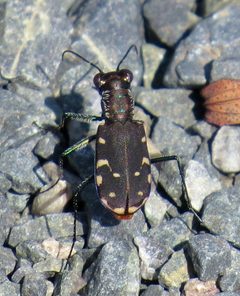
Cicindelidia rufiventris is a tiger found in the eastern and central United States, characterized by its distinctive red-orange visible during . Formerly classified in the Cicindela, it was moved to Cicindelidia based on phylogenetic studies. The species shows clinal variation in coloration and maculation across its range, with southern exhibiting blue coloration and reduced maculations. It is primarily active during summer months and is associated with rocky, open in the Ozark Highlands and similar regions.
Pronunciation
How to pronounce Cicindelidia rufiventris: //sɪˌsɪndəˈlaɪdiə ˌruːfaɪˈvɛntrɪs//
These audio files are automatically generated. While they are not always 100% accurate, they are a good starting point.
Identification
Most reliably distinguished from the closely related Cicindelidia punctulata (formerly Cicindela punctulata) by the absence of a distinct sutural row of green punctures on the . The red-orange , exposed during , provides immediate field recognition. Southern show influence of cumatilis with blue coloration and reduced maculations, while eastern populations are darker with more developed maculations. Missouri populations represent intergrades between these forms.
Images
Habitat
Rocky clay exposures along roadsides, trails, and two-tracks through open pine forests on sandstone substrates. In Missouri, found exclusively in the Ozark Highlands region, particularly in dolomite glades and dry upland forests. Associated with well-drained, rocky soils in open to semi-open woodland settings.
Distribution
Eastern and central United States. Eastern (nominate ) range from the Atlantic coast westward. Populations showing cumatilis influence occur from southwestern Louisiana through eastern Texas, with intergrades extending north into southern Missouri. Absent from the far western United States, where the related Cicindelidia haemorrhagica occurs.
Seasonality
Summer-active . are present and active during July and August in Missouri and surrounding regions. Peak activity coincides with the warmest months of the year.
Behavior
, typical of tiger beetles. are fast-running and capable of . In Missouri, observed to be locally abundant along rocky two-tracks and trails, with individuals sometimes allowing close approach for photography. When disturbed, flies short distances with red conspicuously exposed.
Ecological Role
Predatory in open, rocky woodland . Functions as a visual of small in glade and forest edge . Part of the diverse tiger beetle fauna of the Ozark Highlands, contributing to invertebrate structure in these specialized habitats.
Human Relevance
Subject of conservation interest due to specificity and association with threatened glade . Studied by entomologists and citizen scientists for distribution and monitoring. Photographed by insect macrophotographers; and habitat preferences documented in natural history blogs and scientific publications.
Similar Taxa
- Cicindelidia punctulataLacks red-orange ; possesses distinct sutural row of green punctures on ; more uniformly colored dorsally
- Cicindelidia haemorrhagicaWestern with similar red but distribution; occurs in western North America rather than eastern/central regions
More Details
Taxonomic History
Formerly classified as Cicindela rufiventris; transferred to Cicindelidia based on phylogenetic analysis. The subgenus Cicindelidia, dubbed the 'American Tiger Beetles' by Pearson et al. (2006), includes this and C. punctulata among others.
Subspecies Variation
Southern Missouri represent the northern fringe of an intergrade zone between nominate rufiventris and cumatilis. The latter, ranging from southwestern Louisiana to eastern Texas, shows reduced maculations and blue rather than brown/black coloration. The extreme opposite expression occurs in isolated populations near Boston, designated as subspecies hentzi, with maximally developed elytral maculations.
Conservation Context
has been subject of targeted survey work in Missouri as part of broader tiger conservation assessments. Its association with dolomite glades—rare and threatened in the Ozark Highlands—makes it an for these .