
Cicindelidia politula
(LeConte, 1875)
Limestone Tiger Beetle
Species Guides
3- Cicindelidia politula petrophila(Limestone Tiger Beetle)
- Cicindelidia politula politula(Limestone Tiger Beetle)
- Cicindelidia politula viridimonticola(Limestone Tiger Beetle)
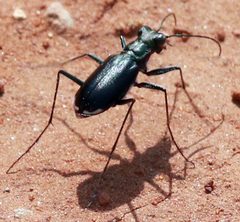
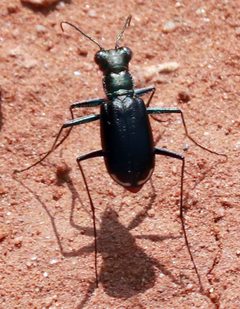
Cicindelidia politula, the Limestone Tiger , is a of tiger beetle occurring primarily in Texas with extensions into Oklahoma. are active in late September and October, inhabiting dry to xeric upland areas with exposed limestone outcroppings. The species is closely related to the more widespread Cicindelidia punctulata but is distinguished by its shiny blue-black to black with white markings absent or limited to the apices, and red . Adults are notably wary and difficult to approach, exhibiting fast escape and challenging capture .
Pronunciation
How to pronounce Cicindelidia politula: //sɪˌsɪndəlˈɪdiə pəˈlɪtjʊlə//
These audio files are automatically generated. While they are not always 100% accurate, they are a good starting point.
Identification
Distinguished from the similar and more common Cicindelidia punctulata by its shiny blue-black to black with white markings absent or limited to the apices (versus more extensive markings in C. punctulata), red , and more metallic appearance. The also occurs in more xeric, limestone-associated than C. punctulata.
Images
Appearance
exhibit shiny blue-black to black with white markings absent or limited to the regions. The is red. The overall coloration is darker and more metallic than the related Cicindelidia punctulata. Body form is typical of tiger beetles with long legs and large, prominent .
Habitat
Dry to xeric upland with exposed limestone outcroppings, including limestone road banks, white limestone exposures along roadsides, and finely ground limestone substrates. are more frequently associated with older, level exposures that have at least a small amount of vegetation; newer or steeply sloped exposures or those completely devoid of vegetation are less frequently occupied.
Distribution
Primarily Texas, USA, with extensions into Oklahoma. Documented from northern Texas (Montague, Johnson, Erath, and Somervell Counties) and southwestern Oklahoma.
Seasonality
active from late September through October. appears dependent on timely rains in xeric , with activity continuing into early fall.
Behavior
are extremely wary and difficult to approach, exhibiting fast, short escape when disturbed. They are challenging to capture due to their ability to quickly find gaps between a net rim and rough, rocky ground. When approached, they may hunker down initially before flying. Under midday sun, adults engage in "sun-facing" , orienting their bodies to minimize thermal exposure. They also exhibit shade-seeking behavior at the base of vegetation such as yucca plants to avoid overheating.
Human Relevance
Subject of interest to coleopterists and macrophotographers due to its restricted distribution and challenging . The has been featured in detailed field accounts documenting the considerable effort required for observation and photography.
Similar Taxa
- Cicindelidia punctulataMore widespread and common with more extensive white elytral markings, less metallic appearance, and broader ; C. politula restricted to limestone habitats with reduced or -only markings
More Details
Taxonomic Note
The has been treated under both Cicindela and Cicindelidia, with current usage favoring Cicindelidia as the . The C. politula politula has been documented from northern Texas.
Photographic Challenges
The has been described as one of the most difficult tiger beetles to photograph due to wariness, fast escape , and the physically demanding nature of working on hard, jagged limestone substrates. Successful field photography typically requires extended effort to habituate individuals to the photographer's presence.