
Cicindela formosa gibsoni
Brown, 1940
Gibson's Big Sand Tiger Beetle, Gibson's Sand Tiger Beetle
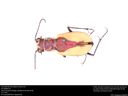
Cicindela formosa gibsoni is a threatened tiger characterized by dramatically expanded white elytral maculations that nearly cover the entire wing surface, creating a striking contrast with its red-purple , , and elytral . The subspecies exhibits a disjunct distribution between the Maybell Sand Dunes in northwestern Colorado and the Great Sand Hills of southwestern Saskatchewan— separated by over 1,000 km. Current taxonomic thinking suggests these populations may represent rather than shared ancestry, with molecular studies ongoing to resolve this question. The subspecies was originally described from Saskatchewan specimens in 1940.
Pronunciation
How to pronounce Cicindela formosa gibsoni: /sɪˈsɪndələ fɔrˈmoʊsə ˈɡɪbsənaɪ/
These audio files are automatically generated. While they are not always 100% accurate, they are a good starting point.
Identification
Distinguished from other C. formosa by the greatly expanded white elytral maculations that nearly cover the entire , leaving only a narrow red-purple sutural area. Differs from C. scutellaris yampae (which shares the 'red, white, and blue' color pattern and ) by having the white markings expanded across the elytra rather than forming discrete spots or bands. Distinguished from C. limbata by larger size, more robust build, and different maculation pattern. The combination of profuse facial setae and metallic blue legs further aids identification.
Images
Habitat
Strictly associated with active sand dune complexes. Occupies sparsely-vegetated interdunal swales on the stoss (windward) side of dunes where vegetation encroachment is highest. Requires open sandy substrate for . In Colorado, found in the Maybell Sand Dunes of Moffat County; in Saskatchewan, restricted to the Great Sand Hills/Elbow Sand Hills active dune complex.
Distribution
to two disjunct localities: (1) Maybell Sand Dunes in northwestern Colorado (Moffat County), USA, and (2) Great Sand Hills/Elbow Sand Hills in southwestern Saskatchewan, Canada. The two are separated by approximately 1,000 km. In Saskatchewan, approximately one-third of the population is concentrated in ~6 ha in the northwestern region of the dune complex.
Seasonality
active in spring, primarily May–June. Activity ceases by mid-day when temperatures rise; beetles begin digging burrows around 2 p.m. when temperatures exceed approximately 80°F (27°C).
Life Cycle
Larvae inhabit sand burrows in dune substrate. Third-instar larvae have been collected in the field and successfully reared to adulthood in captivity. Larval coloration differs between Colorado and Saskatchewan , representing the only consistent morphological difference between the two disjunct populations.
Behavior
engage in thermoregulatory shuttling, moving between exposed and shaded microhabitats to maintain high body temperatures optimal for foraging. When active, flies powerfully across dunes with a characteristic bouncing, tumbling landing. Adults dig burrows for shelter during hot midday periods and overnight. Activity patterns strongly temperature-dependent; cease surface activity when substrate temperatures become excessive.
Ecological Role
in sand dune . distribution appears driven by structure for rather than prey availability or larval habitat quality.
Human Relevance
Subject of conservation concern; listed as threatened. Restricted range makes vulnerable to loss from vegetation encroachment and dune stabilization. Popular target for tiger enthusiasts and photographers due to striking appearance and rarity. Taxonomic status uncertain due to possible convergent origin of disjunct populations, with implications for conservation prioritization.
Similar Taxa
- Cicindela scutellaris yampaeShares 'red, white, and blue' coloration and sand dune in northwestern Colorado; distinguished by discrete maculation pattern rather than expanded white covering most of
- Cicindela formosa generosaWidespread Great Plains with nominate maculation pattern—white markings much reduced compared to gibsoni
- Cicindela limbataSmaller sand-dwelling with different body proportions and maculation; occurs in similar but distinguished by size and pattern
Misconceptions
The name 'gibsoni' has been applied to both Colorado and Saskatchewan , but current evidence suggests these may represent independently derived, convergent populations rather than a single with disjunct distribution. If confirmed, the Colorado population would require a new name, as the type series is from Saskatchewan.
More Details
Taxonomic Uncertainty
Molecular studies are ongoing to determine whether the Colorado and Saskatchewan share ancestry or represent . The was described from Saskatchewan in 1940; if convergence is confirmed, the Colorado population will need a new .
Conservation Status
Listed as threatened. Saskatchewan estimated at 1,106–1,474 (2016–2018), with variation possibly linked to spring rainfall patterns. loss through dune stabilization and vegetation encroachment represents primary threat.
Rearing Notes
Larvae collected from field burrows can be successfully reared to adulthood in containers with native substrate, providing opportunity for study of and confirming larval identification.
Sources and further reading
- BugGuide
- GBIF taxonomy match
- iNaturalist taxon
- NCBI Taxonomy
- Catalogue of Life
- Cicindela formosa gibsoni… or not! | Beetles In The Bush
- ID Challenge #12 | Beetles In The Bush
- 2 days, 6 localities, 10 species… | Beetles In The Bush
- Distribution, abundance, and ecology of the threatened Gibson’s Big Sand Tiger Beetle (Cicindela formosa gibsoni Brown) in the Elbow Sand Hills of Saskatchewan