
Calosoma luxatum
Say, 1823
dislocated beautiful black searcher
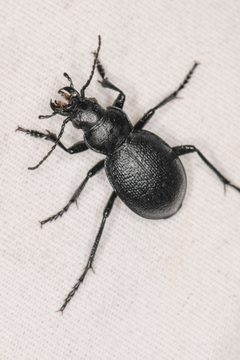
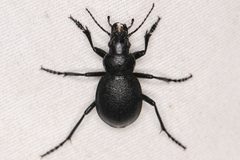
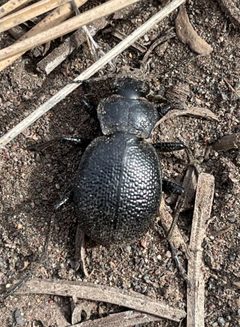
Calosoma luxatum, commonly known as the dislocated beautiful black searcher, is a large ground beetle in the Carabidae. are brachypterous, meaning they have reduced wings and are flightless. The is distributed across western and central North America, from the Canadian prairies through the western United States. It inhabits open short grass prairies and dry forest clearings, where it hunts as an active .
Pronunciation
How to pronounce Calosoma luxatum: //ˌkæl.oʊˈsoʊ.mə lʌkˈseɪ.təm//
These audio files are automatically generated. While they are not always 100% accurate, they are a good starting point.
Identification
are brachypterous, a key distinguishing feature from many congeneric . The specific epithet "luxatum" (Latin for "dislocated") and "dislocated beautiful black searcher" may refer to distinctive morphological features, though precise diagnostic characters distinguishing it from similar Calosoma species require examination of detailed structural features. The species is generally smaller than the closely related Calosoma scrutator (fiery searcher), which exceeds 25 mm in length.
Images
Habitat
Inhabits open short grass prairies and open ground in dry forests. Found in semi-arid to arid environments with sparse vegetation and exposed soil surfaces.
Distribution
North America: Canada (Alberta, British Columbia, Saskatchewan) and United States (Arizona, California, Colorado, Idaho, Kansas, Montana, Nebraska, New Mexico, Nevada, Oregon, South Dakota, Utah, Washington, Wyoming).
Diet
As a member of the Calosoma, it is an active . Specific prey records for this are not documented, but related species in the genus feed on caterpillars and other soft-bodied insects.
Life Cycle
are deposited in soil. Larvae are ground-dwelling . are long-lived, with a life span of two to three years or more based on related .
Behavior
are active that hunt on the ground. Being brachypterous, they are incapable of and must disperse by . They are fast runners, a characteristic of ground beetles in the Carabidae.
Ecological Role
that contributes to regulation of herbivorous insect , particularly caterpillars. As a large, flightless ground beetle, it serves as an indicator of intact prairie and dry forest .
Human Relevance
Like other Calosoma , it may provide of caterpillar pests in agricultural and forest settings. No specific economic importance has been documented for this species.
Similar Taxa
- Calosoma scrutatorLarger size (25 mm or more), fully winged and capable of , more intense purple coloration on pronotum, more elongated and .
- Calosoma wilcoxiSmaller size, arboreal habits (climbs trees to hunt caterpillars), fully winged, associated with forest rather than open prairies.
- Calosoma sayiAll black coloration without metallic highlights, larger size, fully winged, more eastern distribution.
More Details
Brachyptery
The flightless condition of is a significant ecological constraint that limits ability and makes vulnerable to fragmentation. This trait distinguishes C. luxatum from most other North American Calosoma .
Taxonomic history
The specific epithet 'luxatum' (dislocated) and suggest historical recognition of distinctive morphological features, possibly relating to body proportions or structural arrangements compared to other 'searcher' beetles in the .
Sources and further reading
- BugGuide
- Wikipedia
- iNaturalist taxon
- NCBI Taxonomy
- Ground beetles up in the air: Calosoma wilcoxi and Calosoma scrutator — Bug of the Week
- Feasting on the bounty | Beetles In The Bush
- May | 2011 | Beetles In The Bush | Page 2
- Best of BitB 2012 | Beetles In The Bush
- Bug Eric: ID Tip: Ground Beetle or Darkling Beetle?
- November | 2012 | Beetles In The Bush | Page 2