
Idoteidae
Samouelle, 1819
Common Valvetails
Genus Guides
2Idoteidae is a of aquatic isopod crustaceans in the suborder Valvifera, distributed globally in marine and freshwater . The family includes approximately 20 and numerous , with highest diversity in temperate coastal waters. Members range from free-living forms in macroalgae and seagrass beds to commensal species associated with other marine organisms. The family has been extensively studied in Australia, New Zealand, the northeastern Pacific, and the North Atlantic.
Pronunciation
How to pronounce Idoteidae: /aɪˈdoʊtiˌiːdiː/
These audio files are automatically generated. While they are not always 100% accurate, they are a good starting point.
Identification
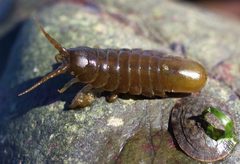
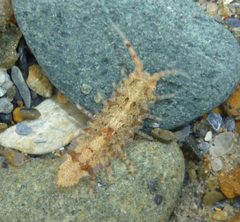
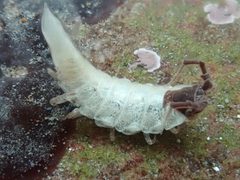
Idoteidae can be distinguished from other valviferan by diagnostic morphological characters, including details of appendage structure. The family is characterized by the valviferan condition in which the uropods form a respiratory chamber covering the pleopods. within the family are distinguished by features of , mouthparts, pereiopods, and pleon structure. identification typically requires examination of male genitalia and detailed morphometric analysis.
Images
Habitat
Most occur in shallow macroalgae and seagrass , with strong association to temperate marine waters. Some species inhabit freshwater streams and brackish lagoons, particularly in southern New Zealand. Marine species are found in intertidal and shallow subtidal zones, with one pelagic species (Idotea metallica).
Distribution
Global distribution with concentrations in temperate coastal waters. Documented from Australia (23 , southern coast between Sydney and Perth), New Zealand (four species, none north of Wellington), northeastern North Pacific (Juan de Fuca Strait to Prince William Sound), Gulf of Mexico, Mediterranean basin, and northeastern Atlantic.
Diet
Freshwater in New Zealand (Austridotea spp.) feed mainly on plant detritus and, to a lesser extent, and . Marine species are generally considered herbivorous or detritivorous, though specific dietary data for most species is limited.
Life Cycle
Direct development with of young; lacks a planktonic larval stage. One freshwater New Zealand (Austridotea annectens) has been observed with a one-year and young released in spring.
Ecological Role
and algivores processing periphyton and decaying plant material in freshwater systems. In marine , function as herbivores and detritivores in macroalgal and seagrass . Some species exhibit commensal relationships with other marine organisms.
Similar Taxa
- ArcturidaeBoth are valviferan ; Idoteidae distinguished by diagnostic appendage characters and preferences
- ChaetiliidaeFormerly included some now excluded from Idoteidae; distinguished by morphological features of pleon and uropods
Sources and further reading
- BugGuide
- Wikipedia
- GBIF taxonomy match
- iNaturalist taxon
- NCBI Taxonomy
- Catalogue of Life
- Idoteidae of Australia and New Zealand (Crustacea : Isopoda : Valvifera)
- New records of Erichsonella attenuata (Isopoda: Valvifera: Idoteidae)in the Gulf of Mexico
- Distribution, ecology, and conservation status of freshwater Idoteidae (Isopoda) in southern New Zealand
- Taxonomy and Distribution of Edotea (= Tropedotea) lyonsi (Menzies and Kruczynski, 1983) N. Comb. (Crustacea: Isopoda: Idoteidae)
- Four new valviferan isopods from diverse tropical Australian habitats (Crustacea: Isopoda: Holognathidae and Idoteidae)
- OBSERVATIONS AND EXPERIMENTS ON THE NATURAL HISTORY AND BEHAVIOR OF THE COMMENSAL ISOPOD COLIDOTEA ROSTRATA (BENEDICT, 1898) (ISOPODA: IDOTEIDAE)
- Population dynamics and reproductive biology of the commensal isopod Colidotea rostrata (Crustacea: Isopoda: Idoteidae)
- Observations and Experiments on the Natural History and Behavior of the Commensal Isopod Colidotea rostrata (Benedict, 1898) (Isopoda: Idoteidae)
- Biology ofChiridotea caeca(Say, 1818) (Isopoda: Idoteidae) in the surfe zone of exposed sandy beaches along the coast of southern New Jersey, USA
- The Idoteidae (Crustacea: Isopoda: Valvifera) of the shallow waters of the northeastern North Pacific Ocean
- Phylogenetic analysis of the north‐east Atlantic and Mediterranean species of the genusStenosoma(Isopoda, Valvifera, Idoteidae)
- New insights into the life-history of the isopod Edotia dahli (Valvifera: Idoteidae): report of host-use and distribution records in the central Chilean coast
- A new isopod species of the genus Edotia (Valvifera, Idoteidae) from Argentina, with a key to South American species.