
Idotea
Fabricius, 1798
Species Guides
4- Idotea balthica(Baltic Isopod)
- Idotea metallica(metallic isopod)
- Idotea phosphorea
- Idotea urotoma(blunt-tailed isopod)
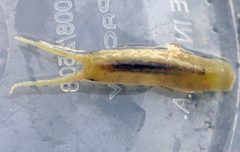
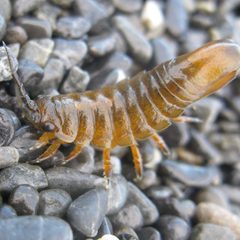
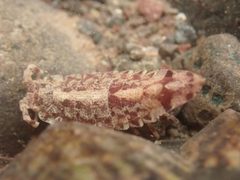
Idotea is a of marine isopod crustaceans inhabiting cold temperate waters. The remains unresolved, with many currently recognized potentially representing synonyms or candidates for reassignment to other genera. Members are associated with seaweed and exhibit flexible habitat selection . The genus includes species with distinct physiological adaptations to different oxygen regimes.
Pronunciation
How to pronounce Idotea: /ɪˈdəʊtiə/
These audio files are automatically generated. While they are not always 100% accurate, they are a good starting point.
Images
Habitat
Marine environments, primarily associated with seaweed substrates including surface-floating seaweed, water column, and bottom-dwelling decaying seaweed. Specific microhabitat preferences vary among and are influenced by competitive interactions.
Distribution
Cold temperate waters. Documented presence in coastal waters of Southeast Alaska and British Columbia (Canada), Denmark, Norway, and Sweden. distributions overlap in some regions, enabling competitive interactions.
Diet
scavengers feeding on large food masses. Diet composition varies by depending on food availability in particular . Feeding involves scraping food material with spines on maxillules and maxillipedes, biting with , and pushing food to molar processes using toothed spines.
Behavior
Flexible selection has been documented in some , with rapid decision-making to avoid superior competitors. Habitat segregation occurs through behavioral displacement rather than fixed preferences. Some species exhibit strong oxyregulation, maintaining aerobic metabolism at low oxygen levels, while others show oxyconformation with metabolism dependent on ambient oxygen partial pressure.
Similar Taxa
- PentidoteaFormerly included now placed in Pentidotea; morphological and ecological similarities may cause confusion
More Details
Taxonomic Uncertainty
The is currently unresolved. Many recognized may be taxonomic synonyms, and some species may be reassigned to different genera.
Species-Level Variation in Physiology
Physiological responses to oxygen deficiency vary among : Idotea baltica exhibits oxyregulation adapted to fluctuating environments, while Idotea emarginata shows oxyconformation typical of stable .
Sources and further reading
- BugGuide
- Wikipedia
- GBIF taxonomy match
- iNaturalist taxon
- NCBI Taxonomy
- Catalogue of Life
- Habitat-related differences in the responses to oxygen deficiencies in Idotea baltica and Idotea emarginata (Isopoda, Crustacea)
- Flexible habitat selection and interactive habitat segregation in the marine congeners Idotea baltica and Idotea emarginata (Crustacea, Isopoda)
- The Ecological Distribution of British Species of Idotea (Isopoda)
- The diet and feeding mechanism of Idotea
- The Life Cycle of the Isopod Idotea emarginata (Fabricius)
- Faculty Opinions recommendation of Flexible habitat selection and interactive habitat segregation in the marine congeners Idotea baltica and Idotea emarginata (Crustacea, Isopoda).
- Mechanisms and consequences of intra- and interspecific interference competition in Idotea baltica (Pallas) and Idotea emarginata (Fabricius) (Crustacea: Isopoda): A laboratory study of possible proximate causes of habitat segregation
- Does the Aquatic Isopod Idotea baltica Minimize the Survival Costs of Reproduction?
- Ecology ofIdoteaspp. (Isopoda) in the northern Baltic
- Distribution and habitat segregation of four species ofIdotea(Isopoda) in a Danish Fjord
- Reproductive ecology of the isopodIdotea baltica(Pallas) in the Northern Baltic
- Local population persistence as a pre-condition for large-scale dispersal of Idotea metallica (Crustacea, Isopoda) on drifting habitat patches
- Herbivory and microhabitat preferences ofIdoteaspp. (Isopoda) in the northern Baltic Sea
- [Effects of detergents on reproduction in Idotea balthica basteri; (Crustacea, Isopoda).]
- Different roles of feeding and protection in diel microhabitat choice of sexes in Idotea baltica